Question
Study the schematic representation of evolutionary history of plant forms given below and mention:
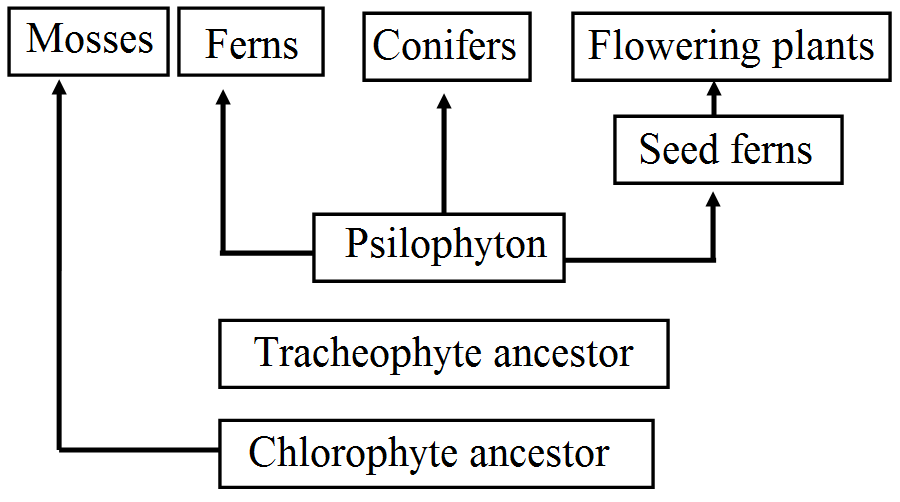
  1. The plant form Ferns and Conifers are most related to.
  2. The nearest ancestors of flowering plants.
  3. The most primitive group of plants
  4. Common ancestry Psilophyton provides to.
  5. The common ancestors of Psilophyton and seed ferns.
  6. The common ancestors of mosses and tracheophytes.
Answer

  1. Psilophyton.
  2. Seed ferns.
  3. Chlorophyte ancestors.
  4. Ferns, Conifers, Seed ferns.
  5. Tracheophyte ancestors.
  6. Chlorophyte ancestors.

Need a full question paper?

Generate a complete, print-ready paper with questions like this in minutes — across 16+ boards, with answer keys.

Start Generating Free

Similar questions

Write a note on heteronuclear RNA and small nuclear RNA.
Explain the effect on the characteristics of a river when urban sewage is discharged into it.
Explain how surrogacy is helpful in case of an infertile woman.
Recombinant DNA-technology is of great importance in the field of medicine. With the help of a flow chart, show how this technology has been used in preparing genetically engineered human insulins.
Although Mendel published his work on inheritance of characters in 1865, for several reasons, it remained unrecognised till 1900. Explain giving three reasons, why it did take so long.
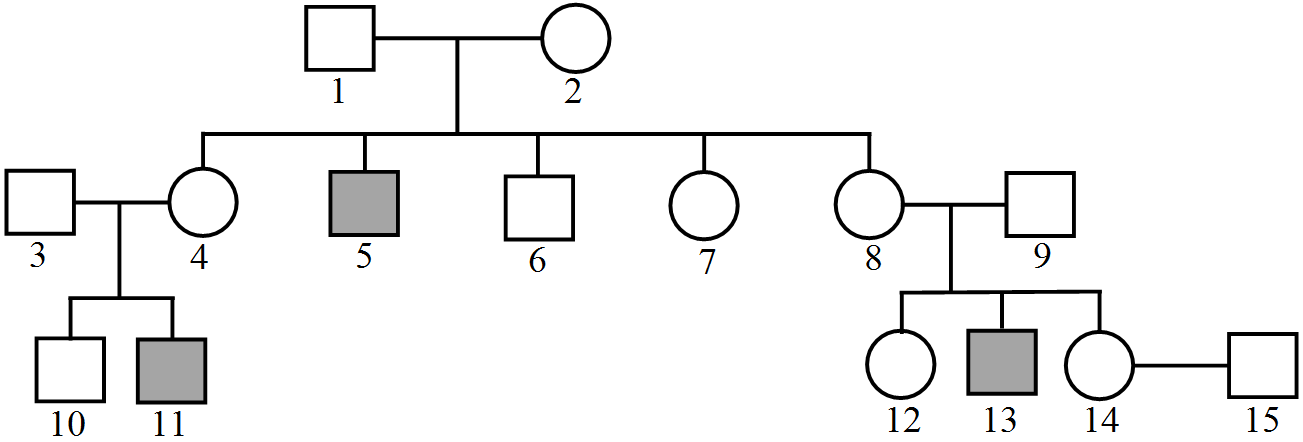
Haemophilia is a sex linked recessive disorder of humans. The pedigree chart given below shows the inheritance of haemophilia in one family. Study the pattern of inheritance and answer the questions given.
  1. Give all the possible genotype of the members 4, 5 and 6 in the pedigree chart.
  2. A blood test shows that the individual 14 is a carrier of haemophilia. The member numbered 15 has recently married the member numbered 14. What is the probability that their first child will be a haemophilic male?
Mention the function of trophoblast in human embryo.
Given below are the stages in human reproduction. Write them in correct sequential order.
Insemination, Gametogenesis, Fertilisation, Parturition, Gestation, Implantation
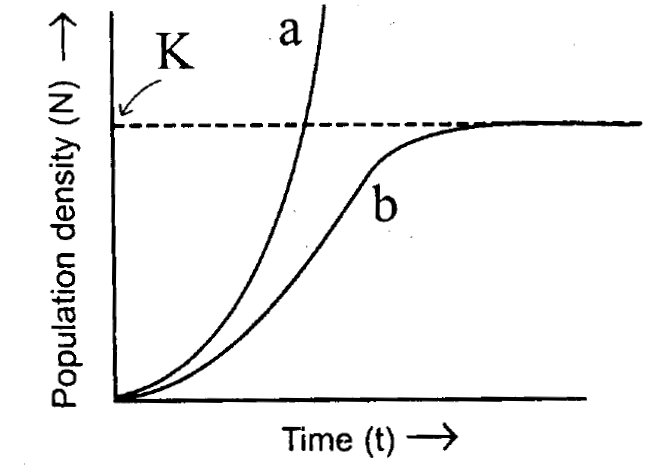
Study the population growth curves in the graph given below and answer the questions which follow:
  1. Identify the growth curves ‘a’ and ‘b'.
  2. Which one of them is considered a more realistic one and why?
  3. If dN/dt=rN(K-N/K) is the equation of the logistic growth curve, what does K stand for?
  4. What is symbolised by N?
The method developed by Eli Lilly using R-DNA technology has received great support from diabetic patients. Explain, how?