Question
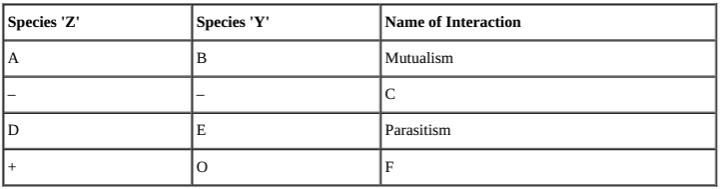
Study the table showing the population interaction between species Z and Y respectively. Assign the appropriate +/– signs for A,B,D,E and respective interactions for C and F.
Image

Answer

A = +
B = +
C = Competition
D = +
E = -
F Commensalism

Need a full question paper?

Generate a complete, print-ready paper with questions like this in minutes — across 16+ boards, with answer keys.
Start Generating Free

Similar questions

Give any six features of the human genome.
  1. A DNA segment has a total of 2,000 nucleotides, out of which 520 are adenine containing nucleotides. How many purine bases this DNA segment possesses?
  2. Draw a diagrammatic sketch of a portion of DNA segment to support your answer.
How does industrial melanism in Biston betularia illustrate the action of natural selection? Explain briefly.
Write the location and function of the Sertoli cells in humans.
Are there any homologous organs in male and female reproductive system? If yes, give examples.
A farmer harvests his crop and expresses his harvest in three different ways.
  1. I have harvested 10 quintals of wheat.
  2. I have harvested 10 quintals of wheat today in one acre of land.
  3. I have harvested 10 quintals of wheat in one acre of land, 6 months after sowing.
Do the above statements mean one and the same thing. If your answer is yes, give reasons. And if your answer is ‘no’ explain the meaning of each expression.
In a monohybrid cross of plants with red and white flowered plants, Mendel got only red flowered plants. On self-pollinating these $F_1$ plants got both red and white flowered plants in 3 : 1 ratio. Explain the basis of using RR and rr symbols to represent the genotype of plants of parental generation.
A schematic diagram of matured human insulin is given below:
Image
How is the process of its formation naturally in the human body different from that of its formation by rDNA technology? Explain.
Name the source of smack. Mention one way in which it affects the human body.
Describe the endosperm development in angiosperms.