MCQ
Substances which have identical chemical properties but differ in atomic weight are called.
  • A
    Isothermals
  • Isotopes
  • C
    Isotropics
  • D
    Elementary particles

Answer

Correct option: B.
Isotopes

Isotopes are atoms of the same element having the same numbers of protons, but different numbers of neutrons. They have same chemical properties due to the same electronic configuration but different physical properties.

Need a full question paper?

Generate a complete, print-ready paper with questions like this in minutes — across 16+ boards, with answer keys.
Start Generating Free

Similar questions

If a charged particle at rest experiences no electromagnetic force:
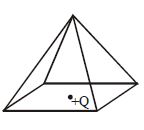
A point charge $+Q$ is positioned at the centre of the base of a square pyramid as shown. The flux through one of the four identical upper faces of the pyramid is
What will be the height of image when an object of 2 mm is placed on the axis of a convex mirror at a distance 20 cm of radius of curvature 40 cm
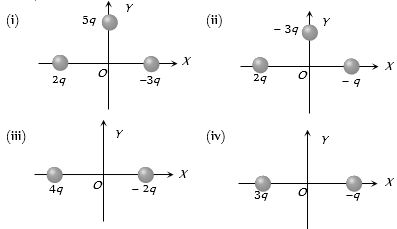
In the following four situations charged particles are at equal distance from the origin. Arrange them the magnitude of the net electric field at origin greatest first
The electric potential at a point on the equatorial line of an electric dipole is:
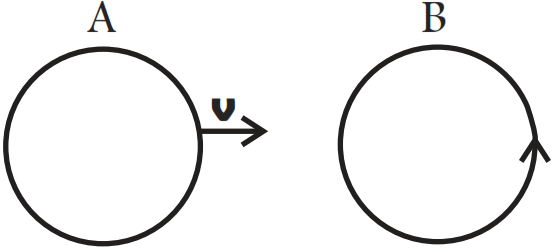
There are two coils $A$ and $B$ as shown in Fig. A current starts flowing in $B$ as shown, when $A$ is moved towards $B$ and stops when $A$ stops moving. The current in $A$ is counterclockwise. $B$ is kept stationary when $A$ moves. We can infer that:
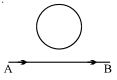
In the arrangement shown in given figure current from $A$ to $B$ is increasing in magnitude. Induced current in the loop will
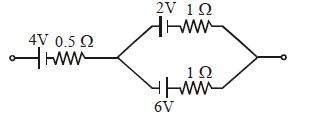
Find the net emf of the three batteries shown in figure ................ $\mathrm{V}$
$A$ thin film of thickness $t$ and index of refraction $1.33$ coats a glass with index of refraction $1.50$. What is the least thickness $t$ that will strongly reflect light with wavelength $600\, nm$ incident normally?.......$nm$
A potentiometer wire of length $L$ and a resistance $r$ are connected in series with a battery of e.m.f. $E_0$ and a resistance $r_1$. An unknown e.m.f. $E$ is balanced at a length $l$ of the potentiometer wire. The e.m.f. $E$ will be given by