Question
Suggest reasons why the B-F bond lengths in $BF_3$ (130pm) and $\text{BF}_4^{-}$ (143pm) differ.
Answer

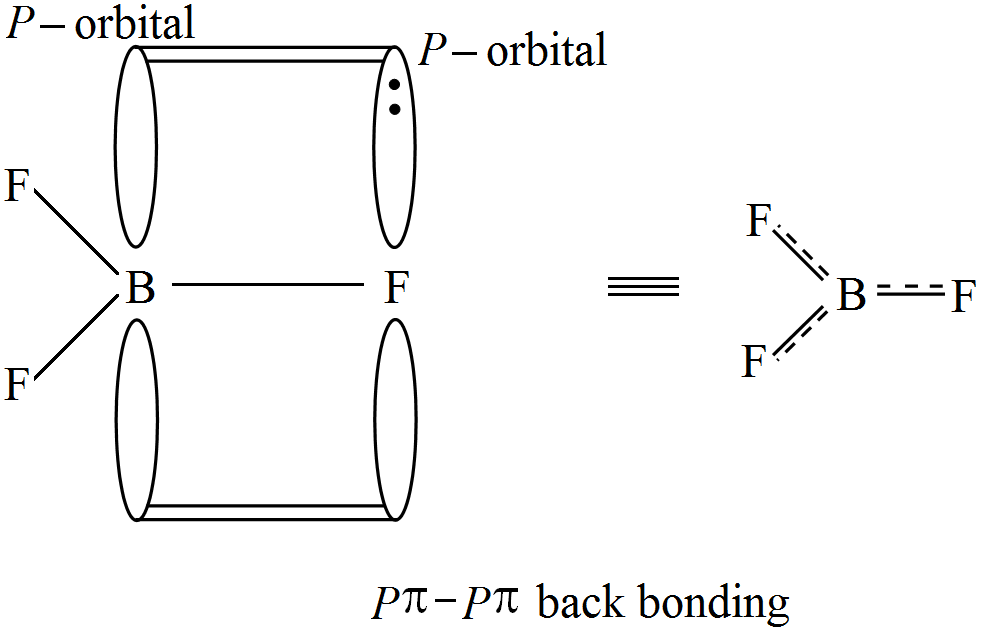
The B-F bond length in $BF_3$ is shorter than the B-F bond length in $\text{BF}_4^{-}$. $BF_3$ is an electron-deficient species. With a vacant p-orbital on boron, the fluorine and boron atoms undergo $\text{p}\pi-\text{p}\pi$ back-bonding to remove this deficiency. This imparts a double-bond character to the B-F bond.

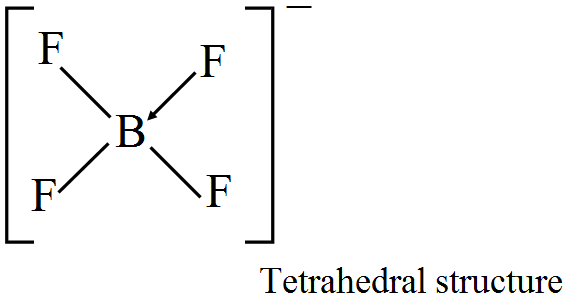
This double-bond character causes the bond length to shorten in $BF_3$ (130 pm). However, when $BF_3$ coordinates with the fluoride ion, a change in hybridisation from $sp^2$ (in $BF_3$) to $sp^3$ $\big(\text{in BF}_4^{-}\big)$ occurs. Boron now forms $4\sigma$ bonds and the double-bond character is lost. This accounts for a B-F bond length of 143pm in $\text{BF}_4^{-}$ ion.

Need a full question paper?

Generate a complete, print-ready paper with questions like this in minutes — across 16+ boards, with answer keys.

Start Generating Free

Similar questions

When $\mathrm{BCl}_3$ is treated with water, it hydrolyses and forms $\left[\mathrm{B}[\mathrm{OH}]_4\right]^{-}$only whereas $\mathrm{AlCl}_3$ in acidified aqueous solution forms $\left[\mathrm{Al}\left(\mathrm{H}_2 \mathrm{O}\right)_6\right]^{3+}$ ion. Explain what is the hybridisation of boron and aluminium in these species?
What is Fajan's law? Also describe the factors affecting it.
Explain the following orders of compounds on the basis of hydrogen bonding:
(i) Boiling point
(ii) Solubility
(iii) Physical state
(iv) Density
  1. Consider the following endothermic reaction:
$\text{CH}_4(\text{g})+\text{H}_2\text{O}(\text{g})\rightleftharpoons\text{CO(g)}+3\text{H}_2(\text{g})$
  1. Write expression for $K_p$ for the above reaction.
  2. How will the values of $K_p$ and composition of equilibrium mixture be affected by.
  1. increasing the pressure.
  2. increasing the temperature.
  3. using a catalyst?
  1. Calculate the pH of the resultant mixture of $10$ml of $0.1$M $H_2SO_4 + 10$ ml of $0.1$M KOH.
Ethyl acetate is formed by the reaction of ethanol and acetic acid and the equilibrium is represented as:
$
CH_3 COOH(l)+C_5 H_5 OH(l) \rightleftharpoons CH_3 COOC_2 H_5(l)+H_2 O(l)
$
a. Write the concentration ratio (reaction quotient), $Q _{ C }$, for this reaction (note: water is not in excess and is not a solvent in this reaction)
b. At 293 K , if one starts with 1.00 mol of acetic acid and 0.18 mol of ethanol, there is 0.171 mol of ethyl acetate in the final equilibrium mixture. Calculate the equilibrium constant.
c. Starting with 0.5 mol of ethanol and 1.0 mol of acetic acid and maintaining it at $293 K, 0.214$ mol of ethyl acetate is found after some time. Has equilibrium been reached?
Attempt any five of the following:
1. If $Qc < Kc$, when we continuously remove the product, what would be the direction of the reaction?
2. Explain the reason for the extraordinary stability of benzene in spite of the presence of three double bonds in it.
3. What effect does branching of an alkene chain has on its boiling point?
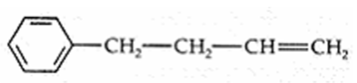
4. Write the IUPAC name:
Image
5. How will you demonstrate that double bonds of benzene are somewhat different from that of olefines?
6. Why do alkynes not show geometrical isomerism?
7. Write an IUPAC name:
Image
Calculate the volume strength of a $3\%$ solution of $H_2O_2$.
What is quantum mechanics? Explain the Schrodinger wave equation for hydrogen.
S. No
Column I
Column II
1.
$Cl_2O$
+7
2.
$Cl_2O_7$
+4
3.
$ClO_2$
+1
4.
$Cl_2O_6$
+6
What is the principle of adsorption chromatography? Explain column chromatography and thin layer chromatography with diagram.