MCQ
Sum of number of $\alpha$ -hydrogen present is compound $A + B$ is

- A$18$
- B$19$
- ✓$20$
- D$21$

Generate a complete, print-ready paper with questions like this in minutes — across 16+ boards, with answer keys.
$(A)$ $SnCl _2 \cdot 2 H _2 O$ is a reducing agent.
$(B)$ $SnO _2$ reacts with $KOH$ to form $K _2\left[ Sn ( OH )_6\right]$.
$(C)$ A solution of $PbCl _2$ in $HCl$ contains $Pb ^{2+}$ and $Cl ^{-}$ions.
$(D)$ The reaction of $Pb _3 O _4$ with hot dilute nitric acid to give $PbO _2$ is a redoxreaction.
(image)
($A$) $R$ is steam volatile
($B$) $Q$ gives dark violet coloration with $1 \%$ aqueous $FeCl_3$ solution
($C$) $S$ gives yellow precipitate with $2, 4$-dinitrophenylhydrazine
($D$) $S$ gives dark violet coloration with $1 \%$ aqueous $FeCl_3$ solution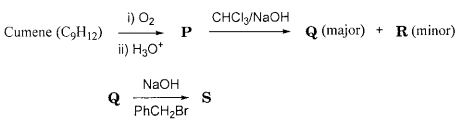
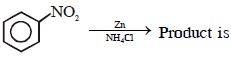
How many ${H^ \ominus }$ shifts are involved in above rearrangement :
The mass (in $\mathrm{mg}$ ) of $\mathrm{S}$ obtained is. . . . . . . [Use molar mass (in g mol ${ }^{-1}$ ) : $\mathrm{H}=1, \mathrm{C}=12, \mathrm{~N}=14, \mathrm{Br}=80$ ]
Complex || Oxidation and number || Electronic configuration