MCQ
Sun radiates continuously and maintains its brightness because
  • A
    Helium is converted into iron in its core
  •  Of fusion of hydrogen nuclei into helium
  • C
     Fusion of helium in hydrogen
  • D
     Burning of carbon, in its core

Answer

Correct option: B.
 Of fusion of hydrogen nuclei into helium
 Of fusion of hydrogen nuclei into helium

Need a full question paper?

Generate a complete, print-ready paper with questions like this in minutes — across 16+ boards, with answer keys.

Start Generating Free

Similar questions

Match List $I$ with List $II$
LIST $I$ LIST $II$
$A$ Planck's constant $( h )$ $I$ $\left[ M ^1 L ^2 T ^{-2}\right]$
$B$ Stopping potential $( Vs )$ $II$ $\left[ M ^1 L ^1 T ^{-1}\right]$
$C$ Work function $(\phi)$ $III$ $\left[ M ^1 L ^2 T ^{-1}\right]$
$D$ Momentum $( p )$ $IV$ $\left[ M ^1 L ^2 T ^{-3} A ^{-1}\right]$
Corpuscular theory of light was advanced by:
A charged particle moves in a uniform magnetic field. The velocity of the particle at some instant makes an acute angle with the magnetic field. The path of the particle will be
move in opposite direction with speed ratio $1: 2$

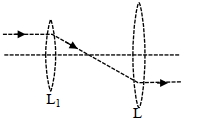
The following figure represents two biconvex lenses $L_1$ and $L_2$ having focal length $10 \mathrm{~cm}$ and $15 \mathrm{~cm}$ respectively. The distance between $\mathrm{L}_1 \& \mathrm{~L}_2$ is :
A current $i$ ampere flows along the inner conductor of a coaxial cable and returns along the outer conductor of the cable, then the magnetic induction at any point outside the conductor at a distance $r$ metre from the axis is
A modified discharge tube is used as a $.......$:
The angle of dip at the magnetic equator is....$^o$
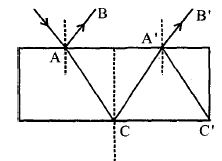
A ray of light of intensity $I$ is incident on a parallel glass slab at point $A$ as shown in diagram. It undergoes partial reflection and refraction. At each reflection, $25\%$ of incident energy is reflected. The rays $AB$ and $A'B'$ undergo interference. The ratio of $I_{max}$ and $I_{min}$ is
According to Joule's law, if the potential difference across a conductor having a material of specific resistance remains constant, then the heat produced in the conductor is directly proportional to
Two condensers of capacities 1μF and 2 μF are connected in series and the system is charged to 120 volts. Then the P.D. on 1 μF capacitor (in volts) will be