MCQ
Suppose $A B C D$ is a trapezium whose sides and height are integers and $A B$ is parallel to $C D$. If the area of $A B C D$ is $12$ and the sides are distinct, then $|A B-C D|$
  • A
    is $2$
  • is $4$
  • C
    is $8$
  • D
    cannot be determined from the data

Answer

Correct option: B.
is $4$
b
(b)

We have,

$A B C D$ is a trapezium.

$A B$ is parallel to $C D$.

Area of trapezium $=12$

$\frac{1}{2} \times h(A B+C D)=12$

$A B+C D=\frac{24}{h}$

Sides and height of trapezium are integer.

$\therefore h$ is a factor of $24$

$h=1,2,3,4,6,8,12,24$

$A B+C D=24,12,8,6,4,3,2,1$

But $A B+C D > h$

$A B+C D=24,12,8,6$

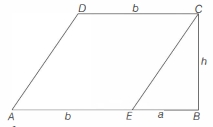
In $\triangle B E C$,

$B E C$ is a right angled triangle.

$\therefore h$ must be $3$ and $4$

When $h=3, B E=4, C E=5$

$A B+C D=8$

$A E+B E+A E=8$

$2 A E=8-B E=8-4$

$A E=2$

$\therefore A B=4+2=6, C D=2$

$\therefore|A B-C D|=|6-2|=4$
Need a full question paper?

Generate a complete, print-ready paper with questions like this in minutes — across 16+ boards, with answer keys.

Start Generating Free

Similar questions

If the $x-$ intercept of some line $L$ is double as that of the line, $3x + 4y = 12$ and the $y-$ intercept of $L$ is half as that of the same line, then the slope of $L$ is
Let $S=S_1 \cap S_2 \cap S_3$, where

$S_1=\{z \in C:|z|<4\}, S_2=\left\{z \in C: \operatorname{Im}\left[\frac{z-1+\sqrt{3} i}{1-\sqrt{3} i}\right]>0\right\} \text { and } $

$S_3:\{z \in C: \operatorname{Re} z>0\} .$

$1.$  Area of $S=$

$(A)$ $\frac{10 \pi}{3}$ $(B)$ $\frac{20 \pi}{3}$ $(C)$ $\frac{16 \pi}{3}$ $(D)$ $\frac{32 \pi}{3}$

$2.$ $\min _{z \in S}|1-3 i-z|=$

$(A)$ $\frac{2-\sqrt{3}}{2}$ $(B)$ $\frac{2+\sqrt{3}}{2}$ $(C)$ $\frac{3-\sqrt{3}}{2}$$(D)$ $\frac{3+\sqrt{3}}{2}$

Give the answer question $1$ and $2$

Let $O$ be the centre of the circle $x ^2+ y ^2= r ^2$, where $r >\frac{\sqrt{5}}{2}$. Suppose $P Q$ is a chord of this circle and the equation of the line passing through $P$ and $Q$ is $2 x+4 y=5$. If the centre of the circumcircle of the triangle $O P Q$ lies on the line $x+2 y=4$, then the value of $r$ is. . . .
If the curve, $y = y ( x )$ represented by the solution of the differential equation $\left(2 x y^{2}-y\right) d x+x d y=0,$ passes through the intersection of the lines, $2 x -3 y =1$ and $3 x+2 y=8,$ then $|y(1)|$ is equal to ...... .
The foot of the coordinates drawn from $(2, 4)$ to the line $x + y = 1$ is
$\frac{{{1^3} + {2^3} + {3^3} + {4^3} + {{........12}^3}}}{{{1^2} + {2^2} + {3^2} + {4^2} + {{.........12}^2}}} = $
A circle ${x^2} + {y^2} + 2gx + 2fy + c = 0$ passing through $(4,\; - 2)$ is concentric to the circle ${x^2} + {y^2} - 2x + 4y + 20 = 0$, then the value of $c$ will be
Solution of the differential equation

$x = 1 + xy\frac{{dy}}{{dx}} + \frac{{{{\left( {xy} \right)}^2}}}{{2!}}{\left( {\frac{{dy}}{{dx}}} \right)^2} + \frac{{{{\left( {xy} \right)}^3}}}{{3!}}{\left( {\frac{{dy}}{{dx}}} \right)^3} + ......$ is

Let $P$ be an interior point of a convex quadrilateral $A B C D$ and $K, L, M, N$ be the mid-points of $A B, B C$, $C D, D A$ respectively. If Area $(P K A N)=25$, Area $(P L B K)=36$, and Area $(P M D N)=41$ then Area $(P L C M)$ is
The line $x - 1 = 0$ is the directrix of the parabola ${y^2} - kx + 8 = 0$. Then one of the values of $k$ is