MCQ
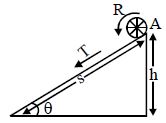
Suppose a body of mass $M$ and radius $R$ is allowed to roll on an inclined plane without slipping from its topmost point $A$. The velocity acquired by the body, as it reaches the bottom of the inclined plane, is given by $\beta  = 1 + \frac{I}{{M{R^2}}}$
  • A
    $\sqrt {2gh} $
  • B
    $\sqrt {\beta  \times 2gh} $
  • $\sqrt {\frac{{2gh}}{\beta }} $
  • D
    ${\frac{{2gh}}{\beta }}$

Answer

Correct option: C.
$\sqrt {\frac{{2gh}}{\beta }} $
c
As the body rolls the inclined plane, it loses potential energy. Howerver, in rolling it acquires both linear and angular speeds and hence, gain in kinetic energy of translation and that of rotation. So by conservation of mechanical energy,

$\mathrm{Mgh}=\frac{1}{2} \mathrm{mv}^{2}+\frac{1}{2} \mathrm{I} \omega^{2}$

But as in rolling, $\mathrm{v}=\mathrm{R} \omega$

${\mathrm{Mgh}=\frac{1}{2} \mathrm{mv}^{2}\left[1+\frac{\mathrm{I}}{\mathrm{MR}^{2}}\right]}$

Let     ${1+\frac{\mathrm{I}}{\mathrm{MR}^{2}}=\beta}$

Let     $\mathrm{Mgh}=\frac{1}{2} \beta \mathrm{Mv}^{2}$

Hence       $v=\sqrt{\frac{2 g h}{\beta}}$

Need a full question paper?

Generate a complete, print-ready paper with questions like this in minutes — across 16+ boards, with answer keys.

Start Generating Free

Similar questions

At a certain temperature, the $r.m.s.$ velocity for ${O_2}$ is $400\, m/sec.$ At the same temperature, the $r.m.s.$ velocity for ${H_2}$ molecules will be ....... $m/sec$
Maxwell distribution function is shown in figure for different gases, which of the following is correct matching?
An observer moves with a constant speed along the line joining two stationary objects. He will observe that the two objects
A symmetrical body of mass $M$ and radius $R$ is rolling without slipping on a horizontal surface with linear speed $v$. Then its angular speed is 
The potential energy of a certain particle is given by $U = \frac{1}{2}\,\left( {{x^2} - {z^2}} \right)$. The force on it is 
A body of mass $40\,kg$ resting on rough horizontal surface is subjected to a force $P$ which is just enough to start the motion of the body. If $\mu_{ s }=5, \mu_{ x }=0.4$, $g =10\,m / s ^2$ and the force $P$ is continuously applied on the body, then the acceleration of the body is $.........m/s^{2}$
At what temperature $r.m.s.$ speed of air molecules doubles of that at $N.T.P.$ is ...... $^oC$
A body of mass $40\,kg$ having velocity $4 \,m/s$ collides with another body of mass $60\,kg$ having velocity $2\, m/s$. If the collision is inelastic, then loss in kinetic energy will be .............. $J$
A uniform chain of length $L$ changes partly from a table which is kept in equilibrium by friction. The maximum length that can withstand without slipping is $l$, then coefficient of friction between the table and the chain is
A projectile of mass $3m$ is moving at $40\, m/s$ at is highest point, where it breaks into two parts $m$ and $2m$. Mass $2m$ moves vertically up at $25\, m/s$. The other part will move at speed  .................... $\mathrm{m}/ \mathrm{s}$