Question
Suppose in an imaginary world the angular momentum is quantized to be even integral multiples of $\frac{\text{h}}{2\pi}$ What is the longest possible wavelength emitted by hydrogen atoms in visible range in such a world according to Bohr's model?
Answer

Even quantum numbers are allowed,

$\text{n}_1=2,\text{n}_2=4\xrightarrow{\ \ \ }$ For minimum energy or for longest possible wavelength.

$\text{E}=13.6\bigg(\frac{1}{\text{n}^2_1}-\frac{1}{\text{n}^2_2}\bigg)$

$\text{E}=13.6\Big(\frac{1}{2^2}-\frac{1}{4^2}\Big)=2.55$

$2.55=\frac{\text{hc}}{\lambda}$

$\lambda=\frac{\text{hc}}{2.55}=\frac{1242}{2.55}$

$\lambda=487.05\text{nm}=487\text{nm}$

Need a full question paper?

Generate a complete, print-ready paper with questions like this in minutes — across 16+ boards, with answer keys.

Start Generating Free

Similar questions

Read the passage given below and answer the following questions from (i) to (v).
A motion that repeats itself at regular intervals of time is called periodic motion. Very often, the body undergoing periodic motion has an equilibrium position somewhere inside its path. When the body is at this position no net external force acts on it. Therefore, if it is left there at rest, it remains there forever. If the body is given a small displacement from the position, a force comes into play which tries to bring the body back to the equilibrium point, giving rise to oscillations or vibrations. Every oscillatory motion is periodic, but every periodic motion need not be oscillatory. Circular motion is a periodic motion, but it is not oscillatory. The smallest interval of time after which the motion is repeated is called its period. Let us denote the period by the symbol T. Its SI unit is second. The reciprocal of T gives the number of repetitions that occur per unit time. This quantity is called the frequency of the periodic motion. It is represented by the symbol n. The relation between n and T is $\text{n}=\frac{1}{\text{T}}$. The unit of n is thus s-1. After the discoverer of radio waves, Heinrich Rudolph Hertz (1857–1894), a special name has been given to the unit of frequency. It is called hertz (abbreviated as Hz). Answer the following.
  1. Every oscillatory motion is periodic motion true or false?
  1. True
  2. False
  1. Circular motion is
  1. Oscillatory motion
  2. Periodic motion
  3. Rotational motion
  4. None of these
  1. Define period. Give its SI unit and dimensions
  2. Define frequency of periodic motion. How it is related to time period
  3. What is oscillatory motion
The escape speed of a projectile on the earth’s surface is 11.2 km s–1. A body is projected out with thrice this speed. What is the speed of the body far away from the earth ? Ignore the presence of the sun and other planets.
Suppose the density of air at Madras is P0 and atomospheric pressure is P0. If we go up, the density and the pressure both decrease. Suppose we wish to calculate the pressure at a height 10km above Madras. If we use the equation P- P = pogz, will we get a pressure more than the actual or less than the actual? Neglect the variation in g. Does your answer change if you also consider the variation in g?
Read the passage given below and answer the following questions from 1 to 5.
Moment of Inertia
A heavy wheel called flywheel is attached to the shaft of steam engine, automobile engine etc., because of its large moment of inertia, the flywheel opposes the sudden increase or decrease of the speed of the vehicle. It allows a gradual change in the speed and prevents jerky motion and hence ensure smooth ride of passengers.
  1. Moment of inertia of a body depends upon:
  1. axis of rotation
  2. torque
  3. angular momentum
  4. angular velocity
  1.  A particle of mass 1 kg is kept at (1m, 1m, 1m). The moment of inertia of this particle about Z-axis would be:
  1. 1 kg-m2
  2. 2 kg-m2
  3. 3 kg-m2
  4. (None of the above)
  1. Moment of inertia of a rod of mass m and length l about its one end is I. If one-fourth of its length is cut away, then moment of inertia of the remaining rod about its one end will be:
  1. $\frac{3}{4}\text{I}$
  2. $\frac{9}{16}\text{I}$
  3. $\frac{27}{64}\text{I}$
  4. $\frac{\text{I}}{16}$
  1. A circular disc is to be made by using iron and aluminium, so that it acquires maximum moment of inertia about its geometrical axis. It is possible with:
  1. iron and aluminium layers in alternate order
  2. aluminium at interior and iron surrounding it
  3. iron at interior and aluminium surrounding it
  4. Either (a) or (c)
  1. Three thin rods each of length L and mass M are placed along X ,Y and Z -axes such that one end of each rod is at origin. The moment of inertia of this system about Z-axis is:
  1. $\frac{2}{3}\text{ML}^2$
  2. $\frac{4\text{ML}^2}{3}$
  3. $\frac{5\text{ML}^2}{3}$
  4. $\frac{\text{ML}^2}{3}$
A pipe 20 cm long is closed at one end. Which harmonic mode of the pipe is resonantly excited by a 430 Hz source? Will the same source be in resonance with the pipe if both ends are open? (Speed of sound in air is $340 ms^{-1}$).
Read the passage given below and answer the following questions from 1 to 5.

PE of Spring

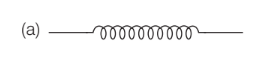
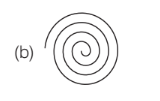
There are many types of spring. Important among these are helical and spiral springs as shown in figure.

Usually, we assume that the springs are massless. Therefore, work done is stored in the spring in the form of elastic potential energy of the spring. Thus, potential energy of a spring is the energy associated with the state of compression or expansion of an elastic spring.
 

  1. The potential energy of a body is increases in which of the following cases?
  1. If work is done by conservative force
  2. If work is done against conservative force
  3. If work is done by non-conservative force
  4. If work is done against non- conservative force
  1. The potential energy, i.e. U (x) can be assumed zero when:
  1. x = 0
  2. gravitational force is constant
  3. infinite distance from the gravitational source
  4. All of the above
  1. The ratio of spring constants of two springs is 2 : 3. What is the ratio of their potential energy, if they are stretched by the same force?
  1. 2 : 3
  2. 3 : 2
  3. 4 : 9
  4. 9 : 4
  1. The potential energy of a spring increases by 15 J when stretched by 3cm. If it is stretched by 4cm, the increase in potential energy is:
  1. 27 J
  2. 30 J
  3. 33 J
  4. 36 J
  1. The potential energy of a spring when stretched through a distance x is 10 J. What is the amount of work done on the same spring to stretch it through an additional distance x?
  1. 10 J
  2. 20 J
  3. 30 J
  4. 40 J
Would you prefer a material with a high melting point or a low melting point to be used as a cathode in a diode?
Read the passage given below and answer the following questions from 1 to 5.
The scalar product or dot product of any two vectors A and B, denoted as A.B (read A dot B) is defined as
$\text{A}\cdot\text{B}=\text{AB}\cos\theta$
Where q is the angle between the two vectors. Since A, B and $\cos\theta$ are scalars, the dot product of A and B is a scalar quantity. Each vector, A and B, has a direction but their scalar product does not have a direction. Following are properties of dot product
  • the scalar product follows the commutative law: A.B = B.A
  • Scalar product obeys the distributive law: (B + C) = A.B + A.C Further, A. $(\lambda\text{B})=\lambda(\text{A}\cdot\text{B})$ where $\lambda$ is a real number.
  • For unit vectors i, j, k we have
i × i = j × j = k × k = 1 and i × j = j × k = k × i = 0
$\text{A}\times\text{A}=\mid\text{A}\parallel\text{A}\mid\cos\theta=\text{A}^2.$
B = 0, if A and B are perpendicular.
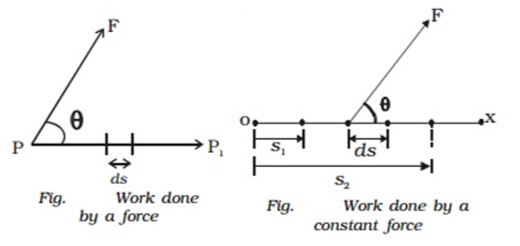
The work done by the force is defined to be the product of component of the force in the direction of the displacement and the magnitude of this displacement. Thus
$\text{W}=(\text{F}\cos\theta)\text{d}=\text{F}\cdot\text{d}$ (We see that if there is no displacement, there is no work done even if the force is large. Work has only magnitude and no direction. Its SI unit is (N m) or joule (J). Thus, When you push hard against a rigid brick wall, the force you exert on the wall does not work.
No work is done if:
  • The displacement is zero.
  • The force is zero. A block moving on a smooth horizontal table is not acted upon by Horizontal force (since there is no friction), but may undergo a large displacement.
  • The force and displacement are mutually perpendicular. This is so since, for $\theta=\frac{\pi}{2}$ rad
  • $\cos\big(\frac{\pi}{2}\big)=\theta.$ For the block moving on a smooth horizontal table, the gravitational force mg does no work since it acts at right angles to the displacement. If we assume that the moon’s orbits around the earth are perfectly circular then the earth’s gravitational force does no work. The moon’s instantaneous displacement is tangential while the earth’s force is radially inwards and $\theta=\frac{\pi}{2}.$
  1. Scalar product A.B = B.A is:
  1. Commutative law
  2. Distributive law
  3. Both a and b
  4. None of these
  1. When force acts in the direction of displacement then work done will be:
  1. Positive
  2. Negative
  3. Both a and b can possible
  4. None of these
  1. Define scalar product. give its properties:
  1. Define work done. Give its SI unit
  1. Write down the conditions for which work done is zero
A kid of mass M stands at the edge of a platform of radius R which can be freely rotated about its axis. The moment of inertia of the platform is I. The system is at rest when a friend throws a ball of mass m and the kid catches it. If the velocity of the ball is v horizontally along the tangent to the edge of the platform when it was caught by the kid, find the angular speed of the platform after the event.