MCQ
Suppose that the speed of sound in air at a given temperature is $400 m/sec$. An engine blows a whistle at $1200 Hz$ frequency. It is approaching an observer at the speed of $100 m/sec$. What is the apparent frequency as heard by the observer .... $Hz$
  • A
    $600$
  • B
    $1200$
  • C
    $1500$
  • $1600$

Answer

Correct option: D.
$1600$
d
(d) $ n' = n\,\left( {\frac{v}{{v - {v_S}}}} \right) = 1200\,\left( {\frac{{400}}{{400 - 100}}} \right) = 1600\,Hz$

Need a full question paper?

Generate a complete, print-ready paper with questions like this in minutes — across 16+ boards, with answer keys.

Start Generating Free

Similar questions

Two bodies are thrown up at angles of $45^o$ and $60^o$, respectively, with the  horizontal. If both bodies attain same vertical height, then the ratio of velocities with which  these are thrown is 
A mass of $10 \,gm$ moving with a velocity of $100\, cm/s$ strikes a pendulum bob of mass $10\, gm$. The two masses stick together. The maximum height reached by the system now is  ............... $cm$ $(g = 10\,m/{s^2})$
If the radius of a solid sphere is $35\,\,cm,$  calculate the radius of gyration when the axis is along a tangent
If the temperature of the sun (black body) is doubled, the rate of energy received on earth will be increased by a factor of
Three weights $W, 2W$ and $3W$ are connected to identical springs suspended from a rigid horizontal rod. The assembly of the rod and the weights fall freely. The positions of the weights from the rod are such that
On doubling the distance between two masses, the gravitational force between the masses:
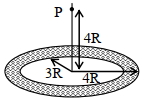
A thin uniform annular disc (see figure) of mass $M$ has outer radius $4 R$ and inner radius $3 R$. The work required to take a unit mass from point $P$ on its axis to infinity is
$10\  m$ is the total mass of a cannon that includs  all shell. Initial cannon is moving with velocity $10\  m$ is along a horizontal frictionless path. If cannon fires $'n$' shells of mass $m$ in the direction of motion of the cannon one by one with velocity $u$ with respect to ground. (neglect any friction force)
Select the incorrect statement
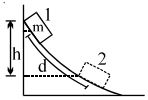
$A$ box of mass $m$ is released from rest at position $1$ on the frictionless curved track shown. It slides a distance $d$ along the track in time $t$ to reach position $2$, dropping a vertical distance $h$. Let $v$ and $a$ be the instantaneous speed and instantaneous acceleration, respectively, of the box at position $2$. Which of the following equations is valid for this situation?