Question
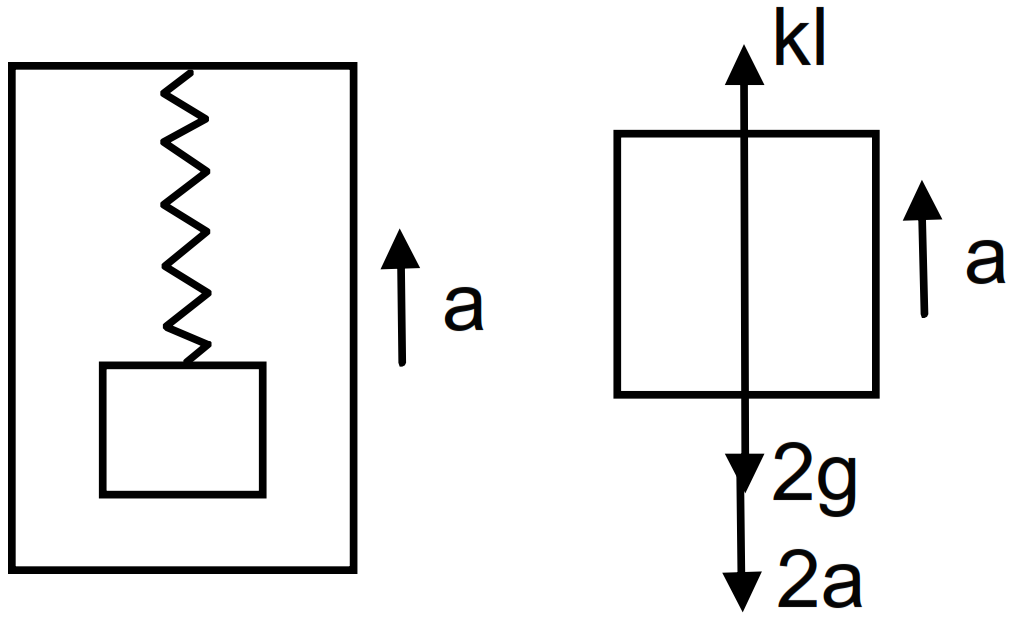
Suppose the ceiling in the previous problem is that of an elevator which is going up with an acceleration of $2.0m/s^2$. Find the elongations.
Answer

$a = 2m/s^2 kl - (2g + 2a) = 0$
$\Rightarrow kl = 2g + 2a = 2 \times 9.8 + 2 \times 2 = 19.6 + 4 = 23.6$
$\Rightarrow\text{I}=\frac{23.6}{100}=0.236\text{m}=0.24\text{m}$

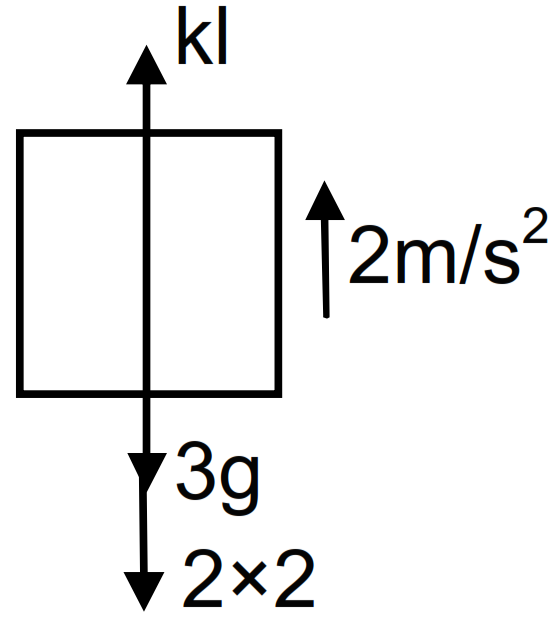
 When $1\ kg$ body is added total mass $(2 + 1)kg = 3\ kg$.
elongation be$ l_1 kl_1 = 3g + 3a = 3 \times 9.8 + 6 = 33.4$
$\Rightarrow\text{I}_1=\frac{33.4}{100}=0.0334=0.36$
Further elongation $= l_1 - l = 0.36 - 0.24 = 0.12m$.

Need a full question paper?

Generate a complete, print-ready paper with questions like this in minutes — across 16+ boards, with answer keys.
Start Generating Free

Similar questions

The convex surface of a thin concavo-convex lens of glass of refractive index $1.5$ has a radius of curvature $20\ cm$. The concave surface has a radius of curvature $60\ cm$. The convex side is silvered and placed on a horizontal surface as shown in figure.
  1. Where should a pin be placed on the axis so that its image is formed at the same place?
  2. If the concave part is filled with water $\Big(\mu=\frac{4}{3}\Big),$ find the distance through which the pin should be moved so that the image of the pin again coincides with the pin.
In an experiment on photoelectric effect, the stopping potential is measured for monochromatic light beams corresponding to different wavelengths. The data collected are $11s$ follows:
wavelength $(nm)$ $350$ $400$ $450$ $500$ $550$
stopping potential$(V):$ $1.45$ $1.00$ $0.66$ $0.38$ $0.16$
Plot the stopping potential against inverse of wavelength $\big(\frac{1}{\lambda}\big) $ on a graph paper and find
  1. The Planck constant,
  2. The work function of the emitter and.
  3. The threshold wavelength.
A spherical capacitor has an inner sphere of radius $12\ cm$ and an outer sphere of radius $13\ cm$. The outer sphere is earthed and the inner sphere is given a charge of $2.5 \mu C$. The space between the concentric spheres is filled with a liquid of dielectric constant $32$.
  1. Determine the capacitance of the capacitor.
  2. What is the potential of the inner sphere?
  3. Compare the capacitance of this capacitor with that of an isolated sphere of radius $12\ cm$. Explain why the latter is much smaller.
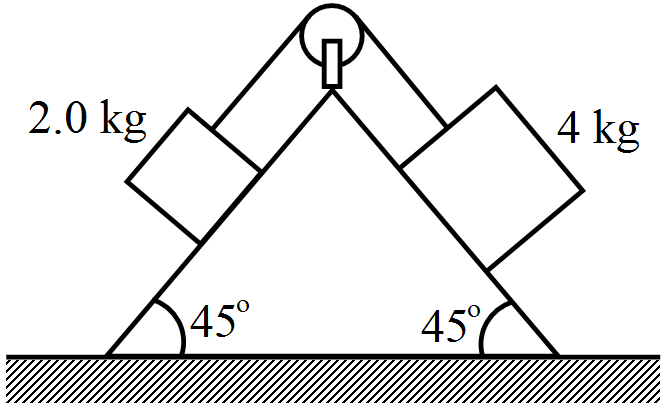
The pulley shown in figure has a radius $10\ cm$ and moment of inertia $0.5\ kg-m^2$ about its axis. Assuming the inclined planes to be frictionless, calculate the acceleration of the $4.0\ kg$ block.
When a Coolidge tube is operated for some time it becomes hot. Where does the heat come from?
A beam of monochromatic light of wavelength $\lambda$ ejects photoelectrons from a cesium surface $\big(\Phi=1.9\text{eV}\big).$ These photoelectrons are made to collide with hydrogen atoms in ground state. Find the maximum value of $\lambda$ for which (a) hydrogen atoms may be ionized, (b) hydrogen atoms may get excited from the ground state to the first excited state and (c) the excited hydrogen atoms may emit visible light.
A car moving at $108\ km/h$ finds another car in front of it going in the same direction at $72\ km/h.$ The first car sounds a horn that has a dominant frequency of $800\ Hz.$ What will be the apparent frequency heard by the driver in the front car? Speed of sound in air $= 330m/s.$
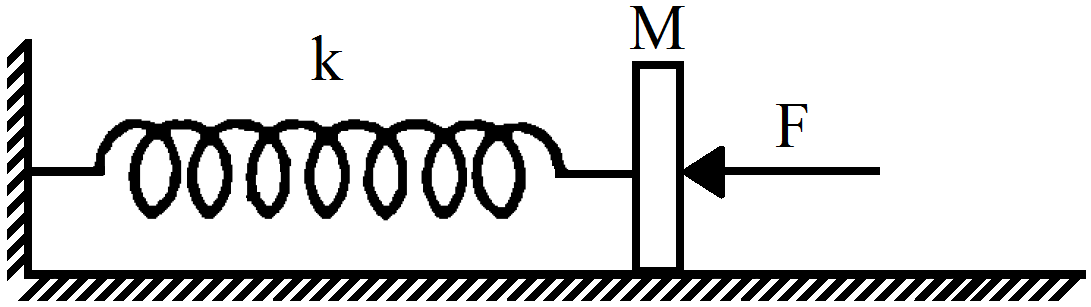
In figure k = 100N/m, M = 1kg and F = 10N,
  1. Find the compression of the spring in the equilibrium position.
  2. A sharp blow by some external agent imparts a speed of 2m/s to the block towards left. Find the sum of the potential energy of the spring and the kinetic energy of the block at this instant.
  3. Find the time period of the resulting simple harmonic motion.
  4. Find the amplitude.
  5. Write the potential energy of the spring when the block is at the left extreme.
  6. Write the potential energy of the spring when the block is at the right extreme.
The answers of (b), (e) and (f) are different. Explain why this does not violate the principle of conservation of energy.
A proton projected in a magnetic field of $0.020T$ travels along a helical path of radius $5.0\ cm$ and pitch $20\ cm.$ Find the components of the velocity of the proton along and perpendicular to the magnetic field. Take the mass of the proton $= 1.6 \times 10^{-27}kg$
Obtain the binding of the nuclei ${ }_{26}^{56} Fe$ and ${ }_{83}^{209} Bi$ in units of MeV from the following data :
$m\left({ }_{26}^{56} Fe \right)=55.934939 u$
$m\left({ }_{83}^{209} Bi \right)=208.980388 u$