Question
Suppose the loop in Exercise 6.4 is stationary but the current feeding the electromagnet that produces the magnetic field is gradually reduced so that the field decreases from its initial value of 0.3T at the rate of 0.02T s–1. If the cut is joined and the loop has a resistance of 1.6Ω, how much power is dissipated by the loop as heat? What is the source of this power?
Answer

Sides of the rectangular loop are 8cm and 2cm.
Hence, area of the rectangular wire loop,
A = length × width
= 8 × 2 = 16cm2
= 16 × 10-4m2
Initial value of the magnetic field, Br = 0.3T
Rate of decrease of the magnetic field, $\frac{\text{dB}}{\text{dt}}=0.02\text{T/s}$
Emf developed in the loop is given as:
$\text{e}=\frac{\text{d}\phi}{\text{dt}}$
$\text{d}\phi=$ Change in flux through the loop area
= AB
$\therefore\ \text{e}=\frac{\text{d(AB)}}{\text{dt}}=\frac{\text{AdB}}{\text{dt}}$
= 16 × 10-4 × 0.02 = 0.32 $\therefore$ 10-4V
Resistance of the loop, $\text{R}=1.6\Omega$
The current induced in the loop is given as:
$\text{i}=\frac{\text{r}}{\text{R}}$
$=\frac{0.32\times10^{-4}}{1.6}=2\times10^{-5}\text{A}$
Power dissipated in the loop in the form of heat is given as:
P = i2R
= (2 × 10⁻⁵)2 × 1.6
= 6.4 × 10-10 W
The source of this heat loss is an external agent, which is responsible for changing the magnetic field with time.

Need a full question paper?

Generate a complete, print-ready paper with questions like this in minutes — across 16+ boards, with answer keys.

Start Generating Free

Similar questions

Consider the situation of the previous problem:
  1. Find the tension in the string in equilibrium.
  2. Suppose the ball is slightly pushed aside and released. Find the time period of the small oscillations.
Prove : $n_{12}=\frac{1}{n_{21}}$
Two bodies of masses m1 and m2 and specific heat capacities s1 and s2 are connected by a rod of length l, cross-sectional area A, thermal conductivity K and negligible heat capacity. The whole system is thermally insulated. At time t = 0, the temperature of the first body is T1 and the temperature of the second body is T2 (T2 > T1). Find the temperature difference between the two bodies at time t.
A hollow sphere is released from the top of an inclined plane of inclination $\theta.$
  1. What should be the minimum coefficient of friction between the sphere and the plane to prevent sliding?
  2. Find the kinetic energy of the ball as it moves down a length 1 on the incline if the friction coefficient is half the value calculated in part (a).
Consider the situation of the previous problem. A charges of -2.0 × 10-4C is moved from the point A to the point B. Find the change in electrical potential energy UB - UA for the cases (a), (b) and (c).
State ampere's law. Obtain expression for magnetic field at a point located (i) externally (ii) internally due to a long cylindrical solid current carrying conductor.###Calculate the value of magnetic field at points $(r>a)$ and $(r
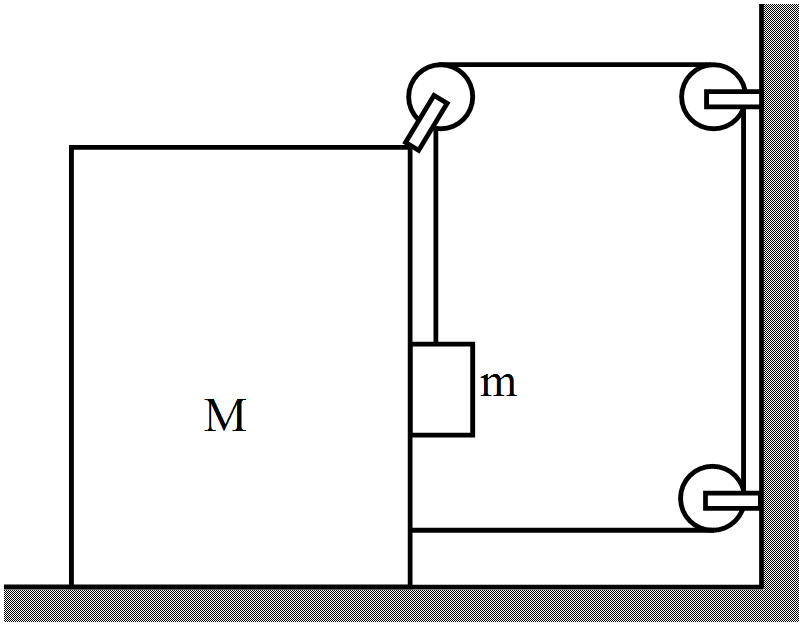
Find the acceleration of the block of mass M in the situation of figure. The coefficient of friction between the two blocks is $\mu_1$ and that between the bigger block and the ground is $\mu_2.$

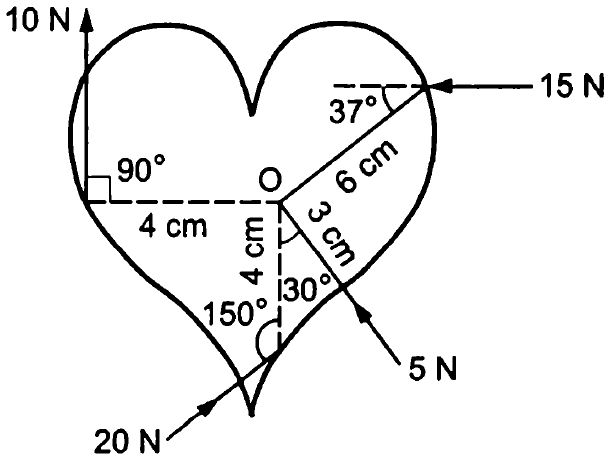
Calculate the total torque acting on the body shown in figure about the point O.

  1. An electron moves along a circle of radius 1m in a perpendicular magnetic field of strength 0.50T. What would be its speed? Is it reasonable?
  2. If a proton moves along a circle of the same radius in the same magnetic field, what would be its speed?
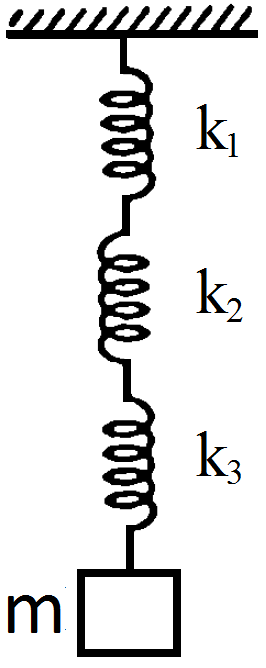
Find the elastic potential energy stored in each spring shown in figure when the block is in equilibrium. Also find the time period of vertical oscillation of the block.