Question
Suppose the platform of the previous problem is brought to rest with the ball in the hand of the kid standing on the rim. The kid throws the ball horizontally to his friend in a direction tangential to the rim with a speed v as seen by his friend. Find the angular velocity with which the platform will start rotating.
Answer

Initial angular momentum = Final angular momentum (The total external torque = 0) Initial angular momentum = mvR (m = Mass of the ball, v = Velocity of the ball, R = Radius of platform) Therefore angular momentum $=\text{l}\omega+\text{MR}^2\omega$ Therefore $\text{mVR}=\text{l}\omega+\text{MR}^2\omega$$\Rightarrow\omega=\frac{\text{mVR}}{(1+\text{MR}^2)}$

Need a full question paper?

Generate a complete, print-ready paper with questions like this in minutes — across 16+ boards, with answer keys.

Start Generating Free

Similar questions

Is neutral temperature always the arithmetic mean of inversion temperature and the temperature of the cold junction? Does the unit of temperature have an effect in deciding this question?
Define temperature on the basis of the zeroth law of thermodynamics.
Calculate the number of degrees of freedom in $15cm^3$ of nitrogen at NTP.
Show graphically how g varies as you move from the centre of earth to great heights above the surface.
A liquid has a definite volume but no shape of its own. Explain.
A wheel is making revolutions about its axis with uniform angular acceleration. Starting from rest, it reaches 100rev/sec in 4 seconds. Find the angular acceleration. Find the angle rotated during these four seconds.
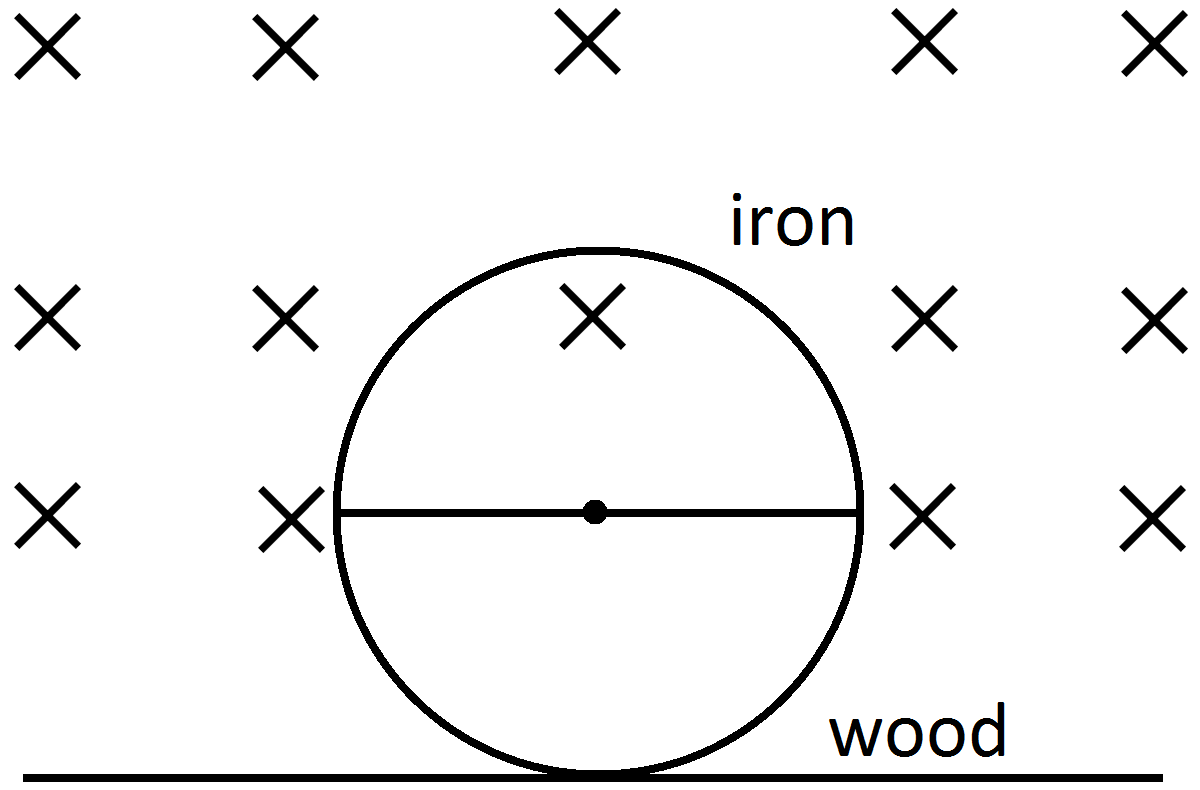
Figure shows a circular wheel of radius 10.0cm whose upper half, shown dark in the figure, is made of iron and the lower half of wood. The two junctions are joined by an iron rod. A uniform magnetic field B of magnitude $2.00 \times 10^{-4} T$ exists in the space above the central line as suggested by the figure. The wheel is set into pure rolling on the horizontal surface. If it takes 2.00 seconds for the iron part to come down and the wooden part to go up, find the average emf induced during this period.
Let $\vec{\text{a}}=2\vec{\text{i}}+3\vec{\text{j}}+4\vec{\text{k}}$ and $\vec{\text{b}}=3\vec{\text{i}}+4\vec{\text{j}}+5\vec{\text{k}}.$ Find the angle between them.
Two successive resonance frequencies in an open organ pipe are 1944Hz and 2592Hz. Find the length of the tube. The speed of sound in air is 324m/s.
Can you ever have a situation in which a light ray goes undeviated through a prism?