Question
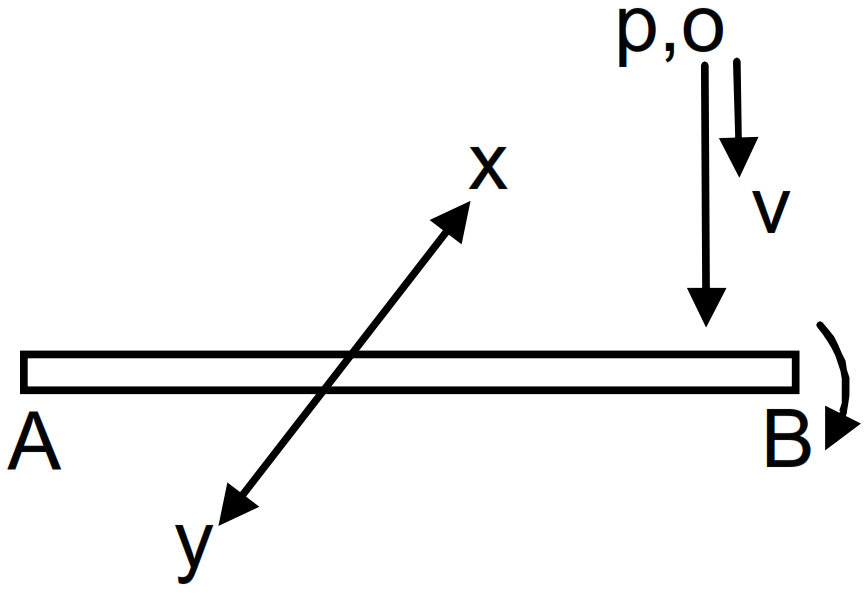
Suppose the rod with the balls $A$ and $B$ of the previous problem is clamped at the centre in such a way that it can rotate freely about a horizontal axis through the clamp. The system is kept at rest in the horizontal position. $A$ particle $P$ of the same mass $m$ is dropped from a height $h$ on the ball $B.$ The particle collides with $B$ and sticks to it:
  1. Find the angular momentum and the angular speed of the system just after the collision.
  2. What should be the minimum value of $h$ so that the system makes a full rotation after the collision.
Answer

  1. The system is kept rest in the horizontal position and a particle $P$ falls from a height h and collides with $B$ and sticks to it.

Therefore, the velocity of the particle $'P\ '$ before collision $=\sqrt{2\text{gh}}$
If we consider the two bodies $P$ and $B$ to be a system. Net external torque and force $= 0$
Therefore, $\text{m}\sqrt{2\text{gh}}=\text{2m}\times\text{v}$
$\Rightarrow\text{v}'=\sqrt{\frac{(2\text{gh})}{2}}$
Therefore angular momentum of the rod just after the collision
$\Rightarrow\text{2m}(\text{v}'\times\text{r})=\text{2m}\times\sqrt{\frac{(2\text{gh})}{2}}\times\frac{\text{l}}2{}$
$\Rightarrow\text{ml}\sqrt{\frac{(2\text{gh})}{2}}$
$\omega=\frac{\text{L}}{\text{l}}=\frac{\text{ml}\sqrt{2\text{gh}}}{2\big(\frac{\text{ml}^2}{4}+\frac{2\text{ml}^2}{4}\big)}$
$=\frac{2\sqrt{\text{gh}}}{\text{3l}}=\frac{\sqrt{8\text{gh}}}{\text{3l}}$
  1. When the mass $2m$ will at the top most position and the mass $m$ at the lowest point, they will automatically rotate. In this position the total gain in potential energy $=2\text{mg}\times\Big(\frac{\text{l}}{2}\Big)-\text{mg}\Big(\frac{\text{l}}{2}\Big)=\text{mg}\Big(\frac{\text{l}}{2}\Big)$
Therefore
$\text{mg}\frac{\text{l}}{2}=\frac{\text{l}}{2}\text{l}\omega^2$
$\Rightarrow\text{mg}\frac{\text{l}}{2}=\frac{\big(\frac{1}{2}\times3\text{ml}^2\big)}{4}\times\Big(\frac{\text{8gh}}{9\text{gl}^2}\Big)$
$\Rightarrow\text{h}=\frac{3\text{l}}{2}$

Need a full question paper?

Generate a complete, print-ready paper with questions like this in minutes — across 16+ boards, with answer keys.

Start Generating Free

Similar questions

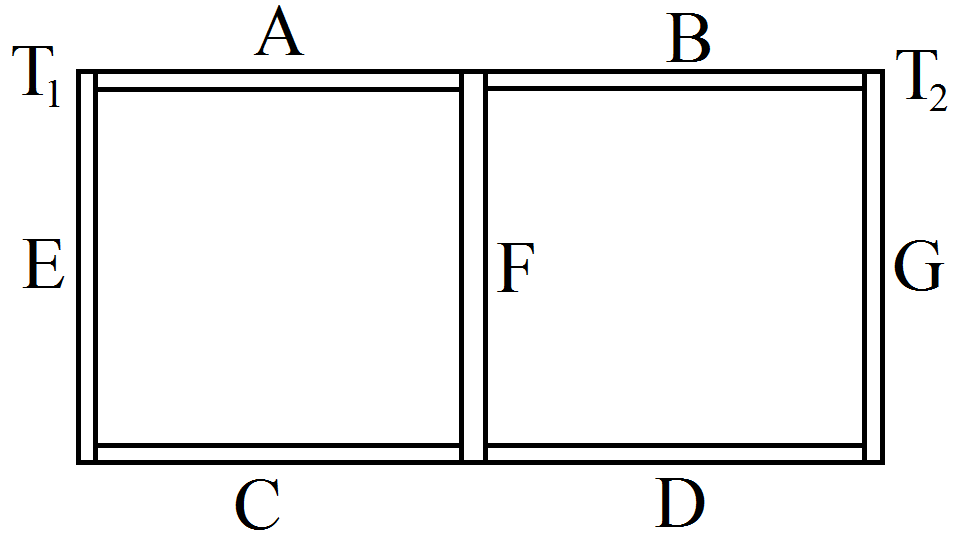
Seven rods $A, B, C, D, E, F$ and $G$ are joined as shown in figure. All the rods have equal cross-sectional area A and length l. The thermal conductivities of the rods are $K_A = K_c = K_0, K_B = K_D = 2K_0, K_E= 3K_0, K_F = 4K_0$, and $K_G = 5K_0$. The rod E is kept at a constant temperature $T_2$ and the rod G is kept at a constant temperature $T_2(T_2 > T_1)$.
  1. Show that the rod F has a uniform temperature $\text{T}=\frac{(\text{T}_1+2\text{T}_2)}{3}.$
  2. Find the rate of heat flowing from the source which maintains the temperature $T_2$.
Name the physical quantity of the dimension given below:
i. $\mathrm{ML}^{\circ} \mathrm{T}^{-3}$
ii. $\mathrm{ML}^{-1} \mathrm{~T}^{-1}$
iii. $\mathrm{M}^{-1} \mathrm{~L}^3 \mathrm{~T}^{-2}$
iv. $\mathrm{ML}^2 \mathrm{~T}^{-3}$
v. $\mathrm{ML}^0 \mathrm{~T}^{-2}$
vi. $\mathrm{T}^{-1}$
A long solenoid of radius $2cm$ has $100$ turns/cm and carries a current of $5A$. A coil of radius 1cm having $100$ turns and a total resistance of $2\Omega$ is placed inside the solenoid coaxially. The coil is connected to a galvanometer. If the current in the solenoid is reversed in direction, find the charge flown through the galvanometer.
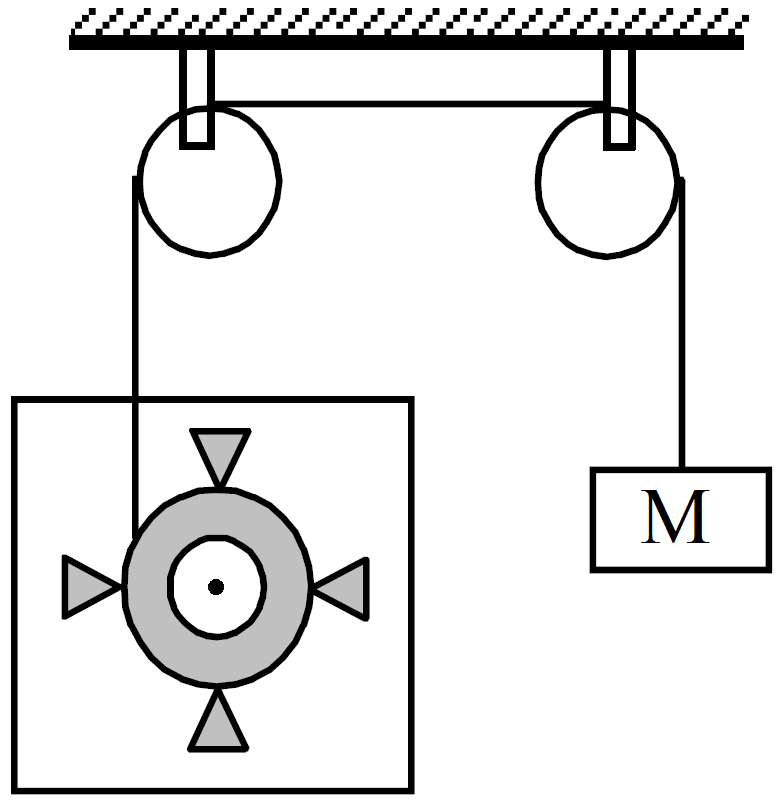
Figure, shows water in a container having $2.0mm$ thick walls made of a material of thermal conductivity $0.50\text{Wm}^{-1}{^{\circ}}\text{C}^{-1}.$ The container is kept in a melting-ice bath at $0^\circ C$. The total surface area in contact with water is $0.05m^2$. A wheel is clamped inside the water and is coupled to a block of mass M as shown in the figure. As the block goes down, the wheel rotates. It is found that after some time a steady state is reached in which the block goes down with a constant speed of $10cms^{-1}$ and the temperature of the water remains constant at $1.0^\circ C$. Find the mass M of the block. Assume that the heat flows out of the water only through the walls in contact. Take $g = 10ms^{-2}$.
Write Newton's formula for the speed of sound in air. Discuss the correction made by Laplace in this formula.
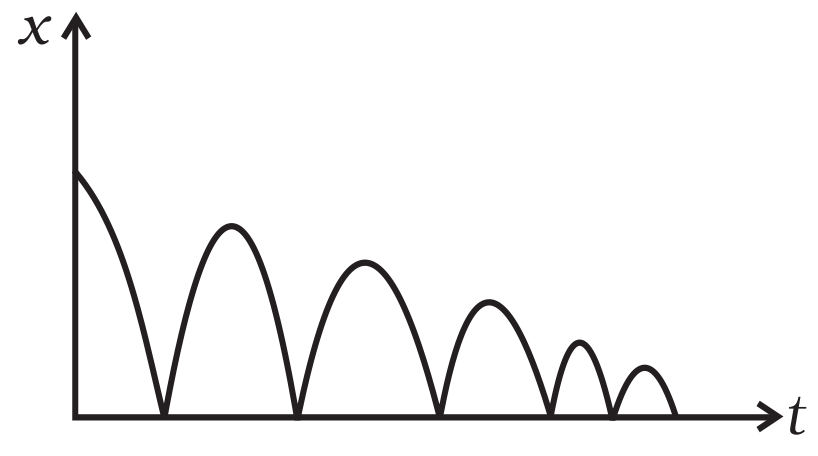
A ball is dropped and its displacement vs time graph is as shown Fig. $($displacement $x$ is from ground and all quantities are $+ve$ upwards$)$.
  1. Plot qualitatively velocity vs time graph.
  2. Plot qualitatively acceleration vs time graph.
A ball of mass m, moving with a speed $2v_0$, collides inelastically $(e > 0)$ with an identical ball at rest. Show that: For a general collision, the angle between the two velocities of scattered balls is less than $90^\circ$
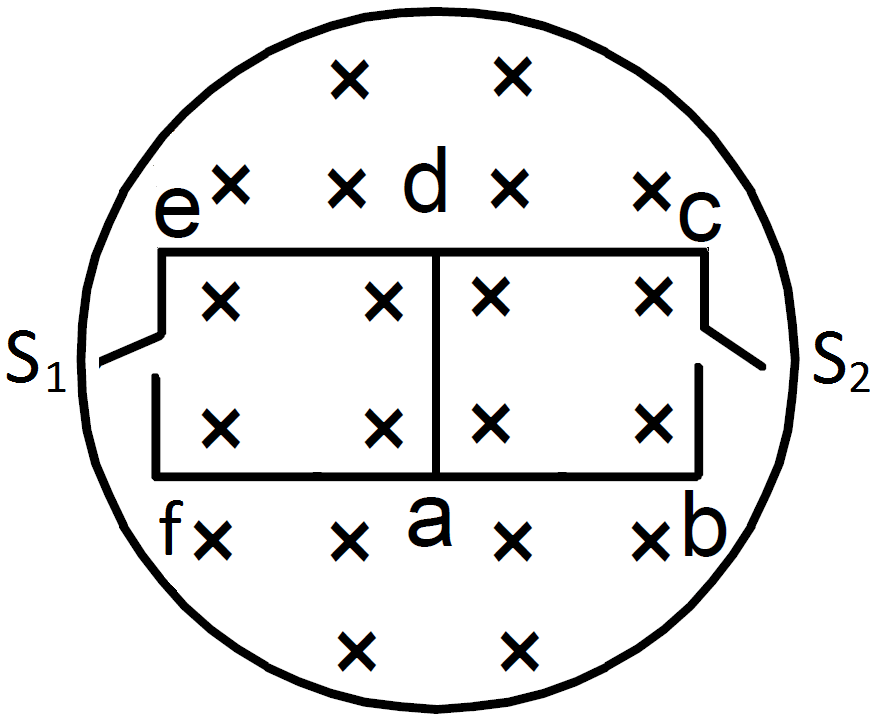
The magnetic field in the cylindrical region shown in figure increases at a constant rate of $20.0mT/s$. Each side of the square loop abcd and defa has a length of $1.00cm$ and a resistance of $4.00\Omega.$ Find the current (magnitude and sense) in the wire ad if:
  1. The switch $S_1$ is closed but $S_2$ is open.
  2. $S_1$ is open but $S_2$ ia closed.
  3. Both $S_1$ and $S_2$ are open.
  4. Both $S_1$ and $S_2$ are closed.
The speed of a motor launch w.r.t still water is $7ms^{-1}$ and the speed of the stream is $3ms^{-1}$. When the launch began travelling upstream, a float was dropped from it. The launch travelled $4.2km$ upstream, turned about and caught up with the float. How long is it, before the launch reached the float?
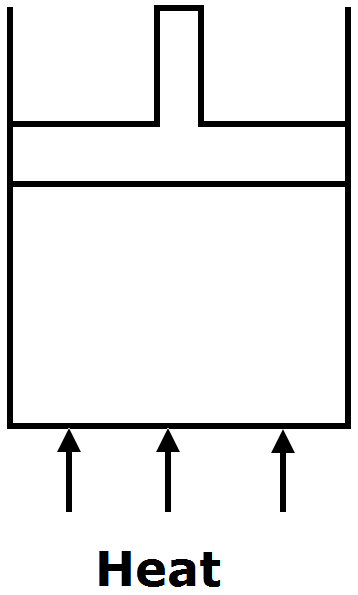
The figure shows a cylindrical container containing oxygen $(\gamma=1.4)$ and closed by a $50 kg$ frictionless piston. The area of cross section is $100 \mathrm{~cm}^2$, atmospheric pressure is 100 kPa and g is $10 \mathrm{~m}-\mathrm{s}^{-2}$. The cylinder is slowly heated for some time. Find the amount of heat supplied to the gas if the piston moves out through a distance of $20 cm$ .