Question
Suppose we want to verify the analogy between electrostatic and magnetostatic by an explicit experiment. Consider the motion of (i) electric dipole p in an electrostatic field E and (ii) magnetic dipole m in a magnetic field B. Write down a set of conditions on E, B, p, m so that the two motions are verified to be identical. (Assume identical initial conditions.)

Answer

Electric field $\vec{\text{E}}$ and magnetic field $\vec{\text{B}}$ are related as
Key concept: Suppose the angle between $\vec{\text{p}}$ and $\vec{\text{E}}$ is $\theta$. Torque on electric dipole of moment $\vec{\text{p}}$ in an electric firld $\vec{\text{E}},\tau=\text{pE}\sin\theta.$
Let us assume that the angle between $\vec{\mu}$ and $\vec{\text{B}}$ is $\theta$.
Torque on magnetic dipole moment $\vec{\mu}$ in magnetic field $\vec{\text{B}}$,
$\vec{\tau}=\mu\text{B}\sin\theta\ \hat{\text{n}}$
If these two motions are identical, then
$\text{pE}\sin\theta=\mu\text{B}\sin\theta$
$\Rightarrow\ \text{pE}=\mu\text{B}\ .....{\text{i}}$
But, $\text{E}=\text{cB}$
$\therefore$ Putting this value in Eq. (i),
$\text{pcB}=\mu\text{B}$
$\Rightarrow\ \text{p}=\frac{\mu}{\text{c}}$

Need a full question paper?

Generate a complete, print-ready paper with questions like this in minutes — across 16+ boards, with answer keys.

Start Generating Free

Similar questions

A conducting square loop having edges of length 2.0cm is rotated through 180° about a diagonal in 0.20s. A magnetic field B exists in the region which is perpendicular to the loop in its initial position. If the average induced emf during the rotation is 20mV, find the magnitude of the magnetic field.
Figure shows a charge array known as an electric quadrupole. For a point on the axis of the quadrupole, obtain the dependence of potential on r for r/a >> 1, and contrast your results with thatdue to an electric dipole, and an electric monopole (i.e., a single charge).

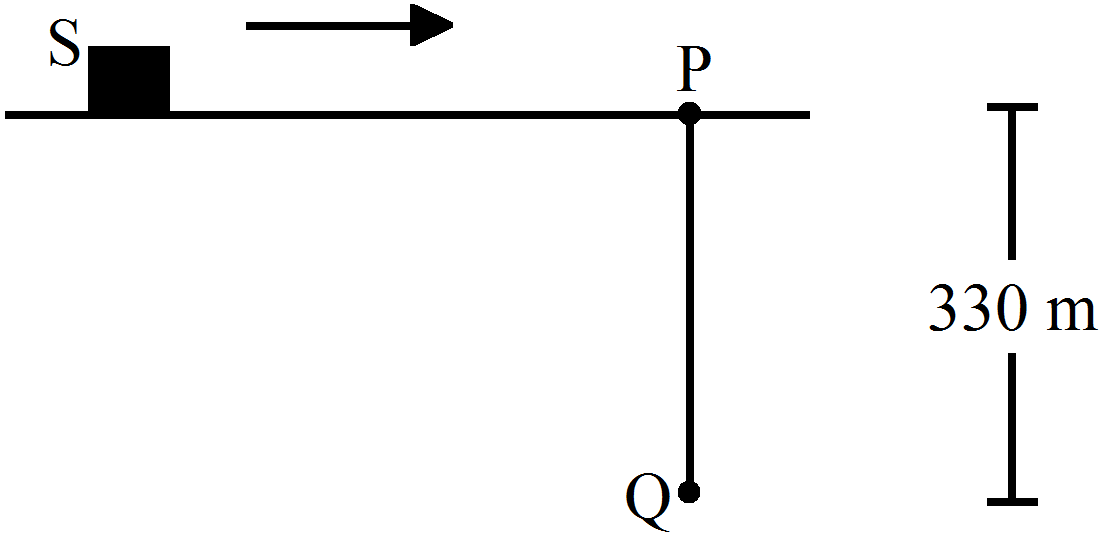
Figure, shows a source of sound moving along the X-axis at a speed of 22m/s continuously emitting a sound of frequency 2.0kHz which travels s in air at a speed of 330m/s. A listener Q stands on the Y-axis at a distance of 330 m from the origin. At t = 0, the source crosses the origin P.

  1. When does the sound emitted from the source at P reach the listener Q?
  2. What will be the frequency heard by the listener at this instant?
  3. Where will the source be at this instant?


What is a transformer? It is of how many types? Explain the principle, construction and working of any transformer.
A person with a normal near point (25 cm) using a compound microscope with objective of focal length 8.0 mm and an eyepiece of focal length 2.5 cm can bring an object placed at 9.0 mm from the objective in sharp focus. What is the separation between the two lenses? Calculate the magnifying power of the microscope.
Consider a wire of length 4m and cross-sectional area 1mm2 carrying a current of 2A. If each cubic metre of the material contains 1029 free electrons, find the average time taken by an electron to cross the length of the wire.
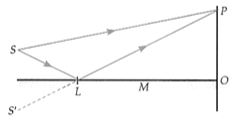
Figure shows an outline of Lloyd's mirror experiment. M is a plane mirror; S is a narrow slit illuminated by some source of light (not shown) and S' is the image of S in M. M, S and S' are in a plane perpendicular to the paper. O is the line of intersection of the mirror and the screen.
a. What is the origin of fringes observed on the screen? 
Image

b. Why is the slit S placed so as to have very oblique angle of incidence of light striking the mirror?
c. The two path lengths PS and PS' are equal when P coincides with O. Yet the fringe at O is found in the experiment to be dark not bright. What does this observation imply?
A solid wire of radius 10cm carries a current 5.0A distributed uniformly over its cross-section. Find the magnetic field B at a point at a distance (a) 2cm (b) 10cm and (c) 20cm away from the axis. Sketch a graph of B versus x for 0 < x < 20cm.
Ram is a  student of class X in a village school. His uncle gifted him a bicycle with a dynamo fitted in it. He was very excited to get it. While cycling during night, he could light the bulb and see the objects on the road. He however, did not know this device works. He asked this question to his teacher. the teacher considered it an opportunity to explain the working to the whole class.
Answer the following question:
  1. State the principle and working of a dynamo.
  2. Write two values each displayed by Ram and his school teacher.
Two tiny spheres carrying charges 1.5 µC and 2.5 µC are located 30 cm apart. Find the potential and electric field:
  1. At the mid-point of the line joining the two charges, and
  2. At a point 10 cm from this midpoint in a plane normal to the line and passing through the mid-point.