Question
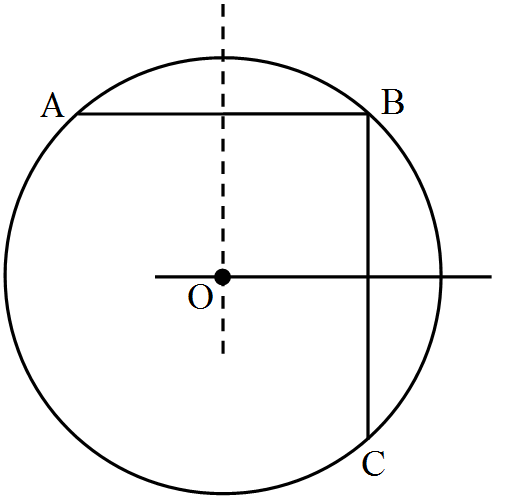
Suppose you are given a circle. Give a construction to find its centre.
Answer

Steps of Construction:
  1. Take three points A, B and C on the given circle.
  2. Join AB and BC.
  3. Draw the perpendicular bisectors of chord AB and BC which intersect each other at O.
  4. Point O will be the required centre of the circle because we know that the perpendicular bisector of the chord always passes through the centre.

Need a full question paper?

Generate a complete, print-ready paper with questions like this in minutes — across 16+ boards, with answer keys.

Start Generating Free

Similar questions

In $\triangle\text{PQR},$ if $\angle\text{P}-\angle\text{Q}=42^\circ$ and $\angle\text{Q}+\angle\text{R}=21^\circ,$ find $\angle\text{P},\angle\text{Q}$ and $\angle\text{R}.$
In a cyclic quadrilateral ABCD if $\text{m}\angle\text{A}=\big(\text{m}\angle\text{C}\big).$ Find $\text{m}\angle\text{A}.$
Draw the graph of the equations given below. Also, find the coordinates of the points where the graph cuts the coordinate axes:
-x + 4y = 8
In a cyclic quadrilateral ABCD, if $(\angle\text{B}-\angle\text{D})=60^\circ,$ show that the smaller of the two is 60°
If the bisectors of two adjacent angles A and B of a quadrilateral ABCD intersect at a point O such that $\angle\text{C}+\angle\text{D}=\text{k}\angle\text{AOB},$ then find the value of k.
If $\text{x}^2+\frac{1}{\text{x}^2}=51,$ find the value of $\text{x}^3-\frac{1}{\text{x}^3}.$
The income and expenditure for 5 years of a family is given in the following data:
Years
1995–96
1996–97
1997–98
1998–99
1999–2000
Income (Rs. In thousands)
100
140
150
170
210
Expenditure (Rs. in thousands)
80
130
145
160
190
Represent the above data by a bar graph.
A rectangular sheet of paper $30cm \times 18cm$ can be transformed into the curved surface of a right circular cylinder in two ways i.e. either by rolling the paper along its length or by rolling it along its breadth.
Find the ratio of the volumes of the two cylinders thus formed.
Find the values of n and $\overline{\text{X}}$ in the following case:$\sum\limits^\text{n}_{\text{i}=1}(\text{x}_\text{i}-10)=30$ and $\sum\limits^\text{n}_{\text{i}=1}(\text{x}_\text{i}-6)=150$
Prove that:$\Big(\frac{1}{4}\Big)^{-2}-3\times8^{\frac{2}{3}}\times4^0+\Big(\frac{9}{16}\Big)^{-\frac{1}{2}}=\frac{16}{3}$