MCQ
Sure check for presence of electric charge is
  • A
    Process of induction
  • Repulsion between bodies
  • C
    Attraction between bodies
  • D
    Frictional force between bodies

Answer

Correct option: B.
Repulsion between bodies
b
(b)

Due to similar (like charge), repulsion force is possible but attraction force may be due to uncharged body.

Need a full question paper?

Generate a complete, print-ready paper with questions like this in minutes — across 16+ boards, with answer keys.
Start Generating Free

Similar questions

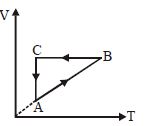
A cyclic process $ABCA$ is  shown in the $V-T$ diagram. Process on the $P-V$ diagram is
A parallel plate capacitor with air between the plates has a capacitance of $9\,pF$. The separation between its plates is $'d'$. The space between the plates is now filled with two dielectrics. One of the dielectrics has dielectric constant $K_1=3$ and thickness $\frac {d}{3}$ while the other one has dielectric constant $K_2 = 6$ and thickness $\frac {2d}{3}$ . Capacitance of the capacitor is now........$pF$
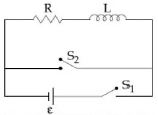
In the circuit shown, The switch $S_1$ is close at time $t = 0$ and the switch $S_2$ is kept open. At some later time $(t_0)$ the switch $S_1$ is opened and $S_2$ is closed. The behaviour of the current $I$ as a function of time $‘t’$ is given by
$Assertion :$ Sound waves cannot travel in vacuum but light can travel in vacuum.
$Reason :$ Sound waves are longitudinal waves and they cannot be polarised but electromagentic waves are transverse and they can be polarised.
Letters $A , B , C$ and $D$ are written on a cardboard as shown in the figure below. The cardboard is kept at a suitable distance behind a transparent empty glass of cylindrical shape. If the glass is now filled with water, one sees an inverted image of the pattern on the cardboard when looking through the glass. Ignoring magnification effects, the image would appear as
A satellite of the earth is revolving in a circular orbit with a uniform speed $v$. If the gravitational force suddenly disappears, the satellite will
A proton of mass $m$ collides elastically with a particle of unknown mass at rest. After the collision, the proton and the unknown particle are seen moving at an angle of $90^o$ with respect to each other. The mass of unknown particle is
An electron with energy $0.1\,ke\,V$ moves at right angle to the earth's magnetic field of $1 \times 10^{-4}\,Wbm ^{-2}$. The frequency of revolution of the electron will be. (Take mass of electron $=9.0 \times 10^{-31}\,kg$ )
The dimensional formula for $r.m.s.$ (root mean square) velocity is
A sample of an ideal gas is taken through a cycle a shown in figure. It absorbs $50J$ of energy during the process $AB$, no heat during $BC$, rejects $70J$ during $CA.$ $40J$ of work is done on the gas during $BC$. Internal energy of gas at $A$ is $1500J$, the internal energy at $C$ would be ........ $J$