Question
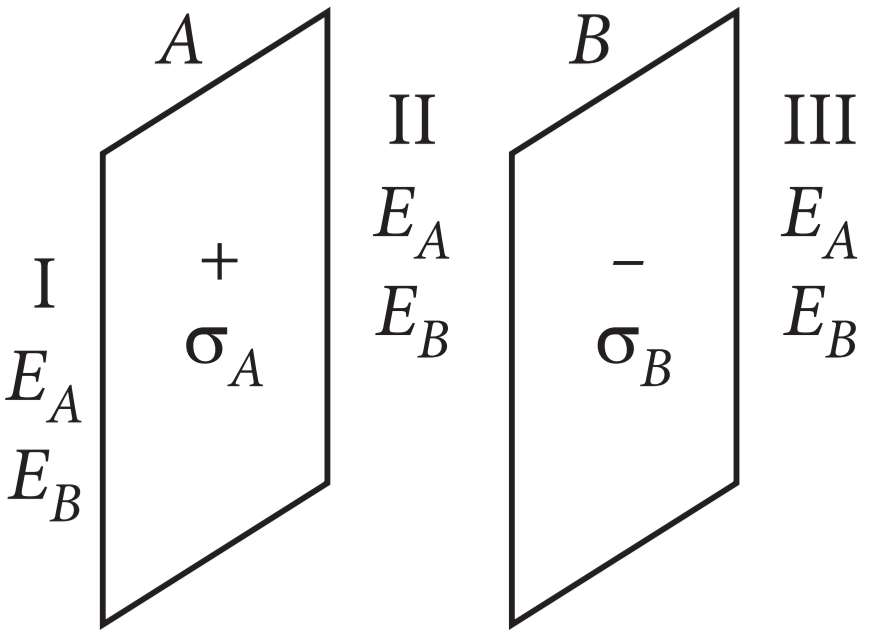
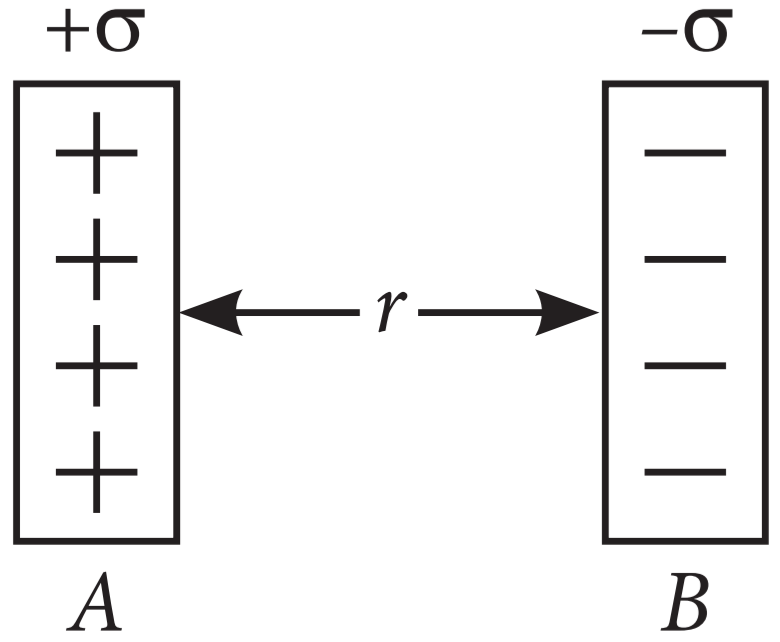
Surface charge density is defined as charge per unit surface area of surface charge distribution. i.e., $\sigma=\frac{\text{dq}}{\text{dS}}.$ Two large, thin metal plates are parallel and close to each other. On their inner faces, the plates have surface charge densities of opposite signs having magnitude of 17.0 × 10-22Cm-2 as shown. The intensity of electric field at a point is $\text{E}=\frac{\sigma}{\in_0},$ where$\in_0=$ permittivity of free space.
  1. E in the outer region of the first plate is:
  1. 17 × 10-22 N/C
  2. 1.5 × 10-25 N/C
  3. 1.9 × 10-10 N/C
  4. Zero.
  1. E in the outer region of the second plate is:
  1. 17 × 10-22 N/C
  2. 1.5 × 10-15 N/C
  3. 1.9 × 10-10 N/C
  4. Zero.
  1. E between the plates is:
  1. 17 × 10-22 N/C
  2. 1.5 × 10-15 N/C
  3. 1.9 × 10-10 N/C
  4. Zero.
  1. The ratio of E from right side of B at distances 2cm and 4cm, respectively is:
  1. 1 : 2
  2. 2 : 1
  3. 1 : 1
  4. $1:\sqrt{2}$
  1. ln order to estimate the electric field due to a thin finite plane metal plate, the Gaussian surface considered is:
  1. Spherical.
  2. Spherical.
  3. Straight line.
  4. None of these.

Answer

  1. (d) Zero.

Explanation:

There are two plates A and B having surface charge densities,

$\sigma_\text{A}=17.0\times10^{-22}\text{C/m}^2$

on A and $\sigma_\text{B}=-17.0\times10^{-22}\text{C/m}^2$on B, respectively. According to Gauss' theorem, if the plates have same surface charge density but having opposite signs, then the electric field in region I is zero.

$\text{E}_\text{I}=\text{E}_\text{A}+\text{E}_\text{B}$

$=\frac{\sigma}{2\in_0}+\Big(-\frac{\sigma}{2\in_0}\Big)=0$

  1. (d) Zero.

​​​​​​​​​​​​​​​​​​​​​​​​​​​​Explanation:

The electric field in region III is also zero.

$\text{E}_\text{III}=\text{E}_\text{A}+\text{E}_\text{B}$

$=\frac{\sigma}{2\in_0}+\Big(-\frac{\sigma}{2\in_0}\Big)=0$

  1. (c) 1.9 × 10-10 N/C

​​​​​​​​​​​​​​​​​​​​​​​​​​​​​​​​​​​Explanation:

In region II or between the plates, the electric field.

$\text{E}_\text{II}=\text{E}_\text{A}-\text{E}_\text{B}$

$=\frac{\sigma}{2\in_0}+=\frac{\sigma}{2\in_0}$

$=\frac{\sigma(\sigma_\text{A}\text{ or }\sigma_\text{B})}{\in_0}=\frac{17.0\times10^{-22}}{8.85\times10^{-12}}$

E = 1.9 × 10-10 N/C

  1. (c) 1 : 1

​​​​​​​​​​​​​​​​​​​​​​​​​​​​​​​​​​​​​​​​​​Explanation:

Since electric field due to an infinite-plane sheet of charge does not depend on the distance of observation point from the plane sheet of charge. So, for the given distances, the ratio of E will be 1 : 1.

  1. (b) Spherical.

​​​​​​​​​​​​​​​​​​​​​​​​​​​​​​​​​​​​​​​​​​​​​​​​​Explanation:

ln order to estimate the electric field due to a thin finite plane metal plate, we take a cylindrical cross-sectional area A and length 2r as the gaussian surface.

Need a full question paper?

Generate a complete, print-ready paper with questions like this in minutes — across 16+ boards, with answer keys.

Start Generating Free

Similar questions

(a) What will be the charge on $12.5 \times 10^8$ electrons?(b) Which is larger between 1 Coulomb charge and 1 electron charge? How many electronic charges will there be in one Coulomb charge?
Two point charges $+3.2 \times 10^{-19}$ Coulomb and $-3.2 \times 10^{-19}$ Coulomb are kept at a distance of 2.4 $\times 10^{-10}$ meters from each other. This dipole is placed at an angle of $30^{\circ}$ to the field direction in a uniform field of intensity of $3 \times 10^4$ Newton/Coulomb. Find the value of the moment of the couple acting on it. What will be the maximum value of this torque?
A metal rod is placed along the axis of a solenoid carrying a high-freqμency alternating current. It is found that the rod gets heated. Explain why the rod gets heated.
An object of size 3.0 cm is placed 14 cm in front of a concave lens of focal length 21 cm. Describe the image produced by the lens. What happens if the object is moved further away from the lens?
A person's skin is more severely burnt when put in contact with 1g of steam at 100°C than when put in contact with 1g of water at 100°C. Explain.
Suppose the bent part of the frame of the previous problem has a thermal conductivity of 780Js-1m-1°C-1 whereas it is 390Js-1m-1°C-1 for the straight part. Calculate the ratio of the rate of heat flow through the bent part to the rate of heat flow through the straight part.
Two blocks of unequal masses are tied by a spring. The blocks are pulled stretching the spring slightly and the system is released on a frictionless horizontal platform. Are the forces due to the spring on the two blocks equal and opposite? If yes, is it an example of Newton's third law?
According to wave theory, the tight of any frequency can emit electrons from metallic surface provided the intensity of light be sufficient to provided necessary energy for emission of electrons, but according to experimental observations, the light of frequency less than threshold frequency can not emit electrons; whatever be the intensity of incident light. Einstein also proposed that electromagnetic radiation is quantised. If photoelectrons are ejected from a surface when light of wavelength $\lambda_1=550\text{nm}$ is incident on it. The stopping potential for such electrons is Vs = 0.19V. Suppose the radiation of wavelength $\lambda_2=190\text{nm}$ is incident on the surface.
  1. Photoelectric effect supports quantum nature oflight because.
  1. There is a minimum frequency of light below which no photoelectrons are emitted.
  2. The maximum K.E. of photoelectric depends only on the frequency oflight and not on its intensity.
  3. Even when the metal surface is faintly illuminated, the photo electrons leave the surface immediately.
  4. Electric charge of the photoelectrons is quantized.
  1. A, B, C
  2. B, C
  3. C, D
  4. A, D, C
  1. ln photoelectric effect, electrons are ejected from metals, if the incident light has a certain minimum.
  1. Wavelength.
  2. Frequency.
  3. Amplitude.
  4. Angle of incidence.
  1. Calculate the stopping potential $\text{V}_{\text{s}_2}$ of surface.
  1. 4.47
  2. 3.16
  3. 2.76
  4. 5.28
  1. Calculate the work function of the surface.
  1. 3.75
  2. 2.07
  3. 4.20
  4. 3.60
  1. Calculate the threshold frequency for the surface.
  1. 500 × 1012Hz
  2. 480 × 1013Hz
  3. 520 × 1011Hz
  4. 460 × 1013Hz
Two q charges of the same nature are located at a distance d from each other, the third charge of value Q Coulomb is at the mid-point of the line joining them. For what value of Q will the system be in equilibrium?
A long bar magnet has a pole strength of 10A-m. Find the magnetic field at a point on the axis of the magnet at a distance of 5cm from the north pole of the magnet.