MCQ
Surface tension of a liquid is found to be influenced by
  • A
    It increases with the increase of temperature
  • B
    Nature of the liquid in contact
  • C
    Presence of soap that increases it
  • Its variation with the concentration of the liquid

Answer

Correct option: D.
Its variation with the concentration of the liquid
d
(d) Surface tension decreases with temperature, presence of soap also reduces it.

It varies with concentration of liquid.

Need a full question paper?

Generate a complete, print-ready paper with questions like this in minutes — across 16+ boards, with answer keys.
Start Generating Free

Similar questions

Two men are carrying a uniform bar of length $L$, on their shoulders. The bar is held horizontally such that younger man gets $(1/4)^{th}$ load. Suppose the younger man is at the end of the bar, what is the distance of the other man from the end
For matter to exist simultaneously in gas and liquid phases
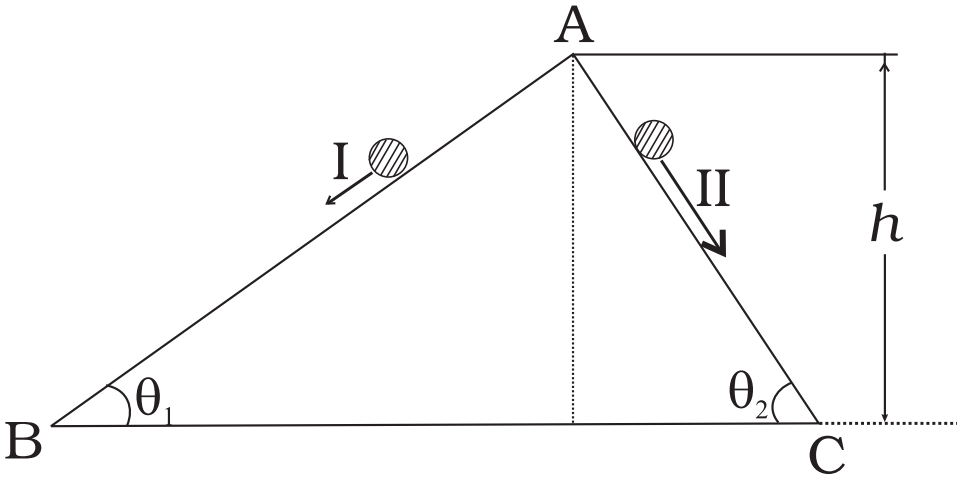
Two inclined frictionless tracks, one gradual and the other steep meet at A from where two stones are allowed to slide down from rest, one on each track as shown in which of the following statement is correct?
A sample of an ideal gas undergoes an isothermal expansion. If $d Q, d U$ and $d W$ represent the amount of heat supplied, the change in internal energy and the work done respectively, then
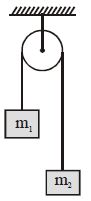
Two masses $m_1 = 3\,kg$ and $m_2 = 7\,kg$ tied to a string are hanging over a light frictionless pulley. What is the acceleration of the masses when system is free to move ? $[g = 10\,m/s^2]$  ...... $m/s^2$
Which of the following statements is correct for any thermodynamic system
A particle of mass m is under the influence of a force $F$ which varies with the displacement $x$ according to the relation $F = - kx + {F_0}$ in which $k$ and ${F_0}$ are constants. The particle when disturbed will oscillate
A mass of 5kg is moving along a circular path of radius 1m. If the mass moves with 300 revolutions per minute, its kinetic energy would be:
For a mole of solid the total energy is:
In a simple pendulum experiment for determination of acceleration due to gravity $(g)$, time taken for $20$ oscillations is measured by using a watch of $1\, second$ least count. The mean value of time taken comes out to be $30\,s$. The length of pendulum is measured by using a meter scale of least count $1\, mm$ and the value obtained is $55.0\, cm$. The percentage error in the determination of $g$ is close to  ........... $\%$