MCQ
Susceptibility of ferromagnetic substance is
  • $> 1$
  • B
    $< 1$
  • C
    $0$
  • D
    $1$

Answer

Correct option: A.
$> 1$
a
Susceptibility ( $\chi$ ) of ferromagnetic substance is positive and very very greater than $1 .$

Ferromagnetic materials such as iron, steel etc. have magnetic susceptibility $>$ $10,000$

Need a full question paper?

Generate a complete, print-ready paper with questions like this in minutes — across 16+ boards, with answer keys.
Start Generating Free

Similar questions

At sun rise or sunset, the sun looks more red than at mid-day because
In a hydrogen like atom, when an electron jumps from the $M -$ shell to the $L-$ shell the wavelength of emitted radiation is $\lambda $. If an electron jumps from $N-$ shell to the $L-$ shell the wavelength of emitted radiation will be
Two masses $8\; kg$ and $12\; kg$ are connected at the two ends of a light inextensible string that goes over a frictionless pulley. Find the acceleration of the masses, and the tension in the string when the masses are released.
A body is at rest at $x=0$. At $t=0$, it starts moving in the positive $x-$ direction with a constant acceleration. At the same instant another body passes through $x=0$ moving in the positive $x$ direction with a constant speed. The position of the first body is given by $x_{1} (t)$ after time $t$ and that of the second body by $x_{2}(t)$ after the same time interval. Which of the following graphs correctly describe $\left(x_{1}-x_{2}\right)$ as a function of time $t$?
A wavelength $0.60 cm$ is produced in air and it travels at a speed of $300 ms^{-1}$. It will be an
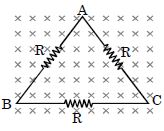
Three resistances of magnitude $R$ each are connected in the form of an equilateral triangle of side $a$ . The combination is placed in a magnetic field $B = {B_0}{e^{ - \lambda t}}$ perpendicular to its plane. The induced current in the circuit is given by 
A $10\,\mu C$ charge is divided into two parts and placed at $1\,cm$ distance so that the repulsive force between them is maximum. The charges of the two parts are :
An electric dipole of moment $\overrightarrow p $ is placed normal to the lines of force of electric intensity $\overrightarrow E $, then the work done in deflecting it through an angle of $180^\circ $ is
For a gas, the difference between the two specific heats is $4150\, J\, kg^{-1}\, K^{-1}$ and the ratio of the two specific heats is $1.4$. What is the specific heat of the gas at constant volume in units of $J\, kg^{-1}\, K^{-1}$ ?
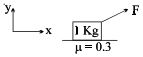
A $\vec F\,\, = \,\,\hat i\, + \,4\hat j\,$ acts on block shown. The force of friction acting on the block is :