Question
Sweety runs around a square park of side $75 m.$ Babul runs around a rectangular with length $60 m$ and breadth $45 m.$ Who covers less distance?

Answer

Perimeter of the square park
$= 4 \times$ Length of a side
$= 4 \times (75 m)$
$= 300 m$
Perimeter of the rectangular park
$= 2 \times ($length $+$ Breadth$)$
$= 2 \times (60 m + 45 m)$
$= 210 m$
Since, the perimeter of the rectangular park is less than the perimeter of the square park, therefore, Bulbul covers less distance.

Need a full question paper?

Generate a complete, print-ready paper with questions like this in minutes — across 16+ boards, with answer keys.

Start Generating Free

Similar questions

Using a protractor, draw $\angle\text{BAC}$ of measure $45^\circ .$ Take a point $P$ in the interior of $\angle\text{BAC}.$ From $P$ draw line segments $PM$ and $PN$ such that $\text{PM}\perp\text{AB}$ and $\text{PN}\perp\text{AC},$ Measure $\angle\text{MPN}.$
The following data gives the production of food grains (in thousand tones) for some years:
Years
$1995$
$1996$
$1997$
$1998$
$1999$
$2000$
Production (in thousand tonnes)
$120$
$150$
$140$
$180$
$170$
$190$
Represent the above data with the help of a bar graph.
Draw a line segment $AB = 5.6\ cm.$ Draw the right bisector of $AB.$
Match the following:
$1.$
$625 \times 436 = 625 \times 400 + 625 \times 30 + 625 \times 6$
$a$
Commutativity under addition.
$2.$
$25 \times 69 \times 8 = 25 \times 8 \times 69$
$b$
Commutativity under multiplication.
$3.$
$60 + 19758 + 840 = 60 + 940 + 19758$
$c$
Distributivity of multiplication over addition.
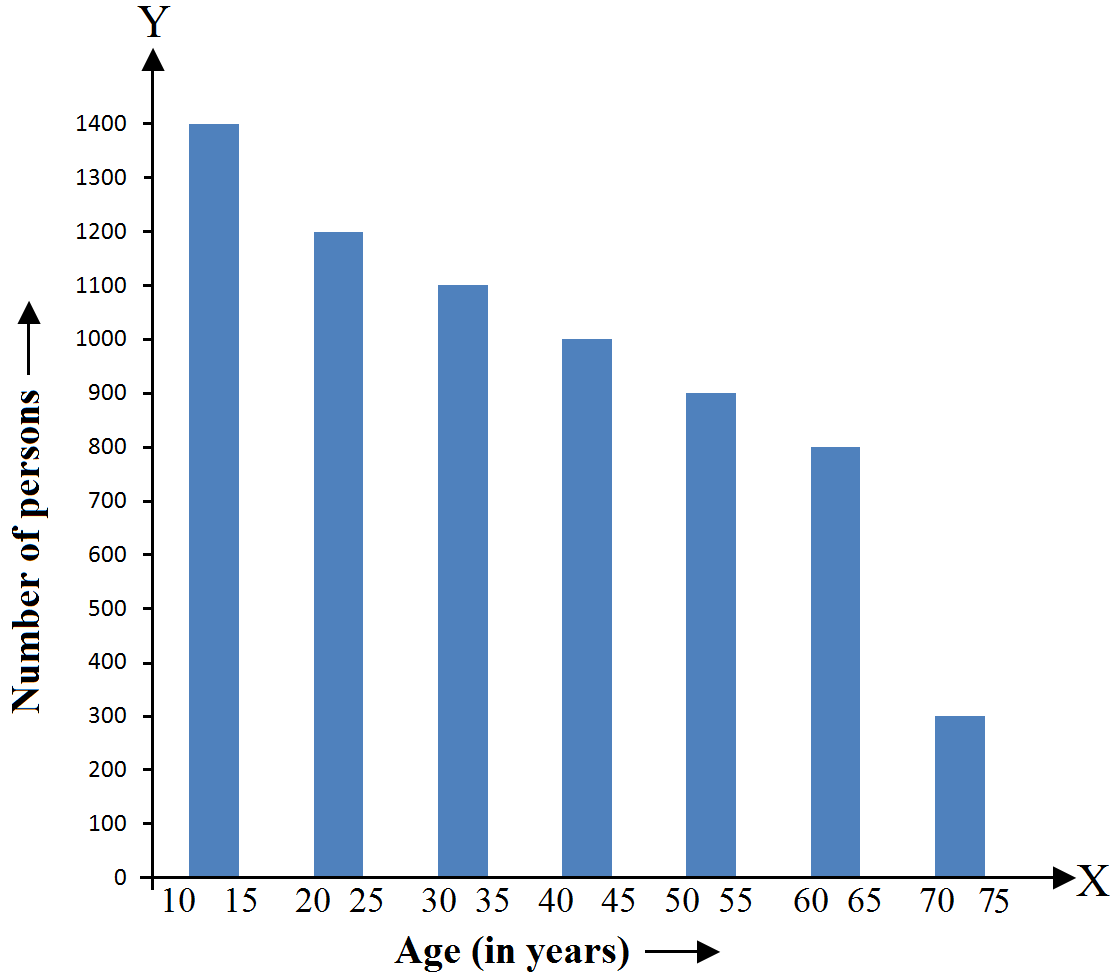
Study the bar graph representing the number of persons in various age groups in a town shown in Observe the bar graph and answer the following questions:

$i.\ $What if the percentage of the youngest age$-$group persons over those in the oldest age group?
$ii.\ $What is the total population of the town?
$iii.\ $What is the number of persons in the age$-$group $60$-$65$?
$iv.\ $How many persons are more in the age$-$group $10$-$15$ than in the age group $30$-$35$?
$v.\ $What is the age$-$group of exactiy $1200$ persons living in the town?
$vi.\ $What is the total number of persons living in the town in the age$-$group $50$-$55$?
$vii.\ $What is the total muner of persons living in the town in the age$-$groups $10$-$15$ and $60$-$65$?
$viii.\ $Whether the population in general increases, decreases or remains constant with the increase in the age$-$group.
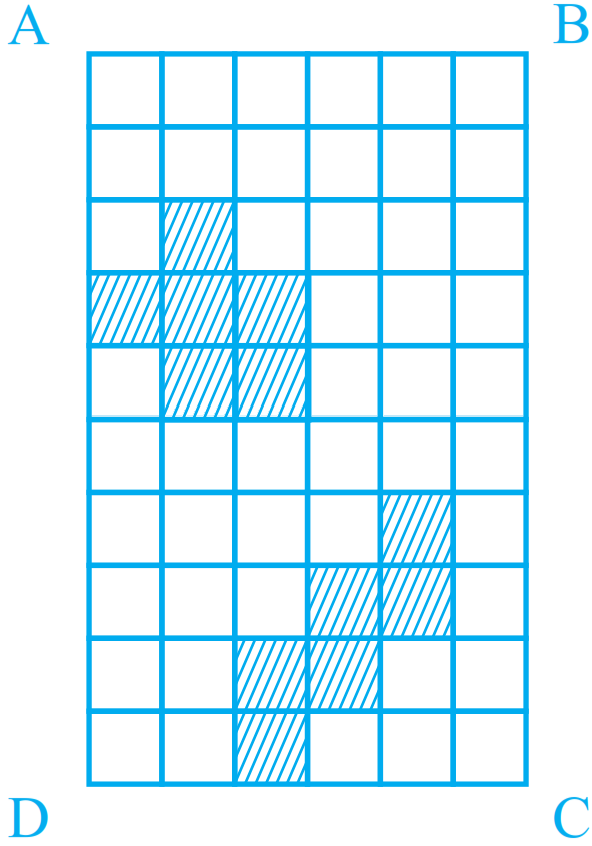
In Fig. each square is of unit length

$a.\ $What is the perimeter of the rectangle $ABCD?$
$b.\ $What is the area of the rectangle $ABCD?$
$c.\ $Divide this rectangle into ten parts of equal area by shading squares. $($Two parts of equal area are shown here$)$
$d.\ $Find the perimeter of each part which you have divided. Are they all equal?
Using a protractor, draw $\angle\text{BAC}$ of measure $70^\circ .$ On side $AC,$ take a point $P,$ such that $AP = 2\ cm.$ From $P$ draw a line perpendicular to $AB.$

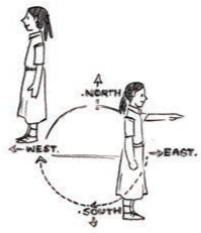
Which direction will you face if you start facing east and make $1\frac{1}{2}$ of a revolution clockwise?
Find the value of $– 8 – (–10)$ using number line
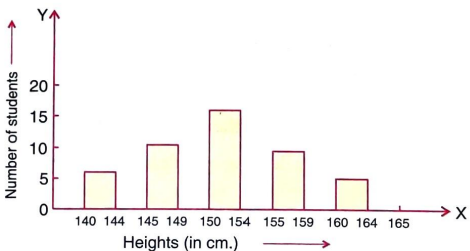
The following bar graph Fig. represents the heights (in cm) of 50 students of Class XI of a particular school. Study the graph and answer the following questions:
Image
(i) What percentage of the total number of students have their heights more than 149 cm?
(ii) How many students in the class are in the range of maximum height of the class?
(iii) The school wants to provide a particular type of tonic to each student below the height of 150 cm to improve his height. If the cost of the tonic for each student comes out to be ₹55, how much amount of money is required?
(iv) How many students are in the range of shortest height of the class?
(v) State whether true or false:
(a) There are 9 students in the class whose heights are in the range of 155-159 cm.
(b) Maximum height (in cm) of a student in the class is 17.
(c) There are 29 students in the class whose heights are in the range of 145-154 cm.
(d) Minimum height (in cm) of a student is the class is in the range of 140-144 cms.
(e) The number of students in the class having their heights less than150 cm is 12.
(f) There are 14 students each of whom has height more than 154 cm.