MCQ
Swimming is possible on account of
  • A
    First law of motion
  • B
    Second law of motion
  • Third law of motion
  • D
    Newton's law of gravitation

Answer

Correct option: C.
Third law of motion
c
(c)Swimming is a result of pushing water in the opposite direction of the motion.

Need a full question paper?

Generate a complete, print-ready paper with questions like this in minutes — across 16+ boards, with answer keys.

Start Generating Free

Similar questions

A particle has displacement of $12 \,m$ towards east and $5 \,m$ towards north then $6 \,m $ vertically upward. The sum of these displacements is........$m$
A spring balance is graduated on sea level. If a body is weighed with this balance at consecutively increasing heights from earth's surface, the weight indicated by the balance
A tuning fork of frequency $280\,\, Hz$ produces $10$ beats per sec when sounded with a vibrating sonometer string. When the tension in the string increases slightly, it produces $11$ beats per sec. The original frequency of the vibrating sonometer string is ... $Hz$
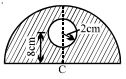
In the figure shown a hole of radius $2\, cm$ is made in a semicircular disc of radius $6\pi$ at a distance $8 \,cm$ from the centre $C$ of the disc. The distance of the centre of mass of this system from point $C$ is  ......... $cm$.
The reading of pressure metre attached with a closed pipe is $4.5 \times 10^4 \mathrm{~N} / \mathrm{m}^2$. On opening the valve, water starts flowing and the reading of pressure metre falls to $2.0 \times 10^4 \mathrm{~N} / \mathrm{m}^2$. The velocity of water is found to be $\sqrt{\mathrm{V}} \mathrm{m} / \mathrm{s}$. The value of $\mathrm{V}$ is__________
A body of mass $5\, kg$ is placed at the origin, and can move only on the $ x-$axis. A force of $10\, N$ is acting on it in a direction making an angle of ${60^o}$ with the $x-$axis and displaces it along the $x-$axis by $4 \,metres$. The work done by the force is......$J$
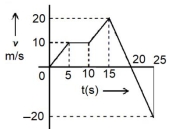
From the $v$ - $t$ graph shown. the ratio of distance to displacement in $25\,s$ of motion
Two masses of $10 \,kg$ and $20 \,kg$ respectivety are connected by a massless spring as shown in fig. A force of $200 \,N$ acts on the $20 \,kg$ mass At the instant shown the $10 \,kg$ mass has acceleration $12 \,m / s ^2$ towards right. The acceleration of $20 \,kg$ mass at this instant is ........ $m / s ^2$
Find the value of $\frac{1.53 \times 0.9995}{1.592}$ with due regard for significant figures
The temperature at which the surface tension of water is zero