MCQ
$t_{1/4}$ for first order reaction is given as
  • A
    ${t_{1/4}} = \frac{{2.303}}{K}\,\log \,4$
  • B
    ${t_{1/4}} = \frac{{2.303}}{K}\,\log \,2$
  • ${t_{1/4}} = \frac{{2.303}}{K}\,\log \,\frac{4}{3}$
  • D
    ${t_{1/4}} = \frac{{2.303}}{K}\,\log \,\frac{3}{4}$

Answer

Correct option: C.
${t_{1/4}} = \frac{{2.303}}{K}\,\log \,\frac{4}{3}$
c
$\mathrm{t}_{1 / 4}=\frac{2.303}{\mathrm{k}} \log \frac{[\mathrm{A}]_{0}}{[\mathrm{A}] \mathrm{t}}$

$\mathrm{t}_{1 / 4}=\frac{2.303}{\mathrm{k}} \log \frac{[\mathrm{A}]_{0}}{3[\mathrm{A}]_{0}} \times 4$

$t_{1 / 4}=\frac{2.303}{k} \log \frac{4}{3}$

Need a full question paper?

Generate a complete, print-ready paper with questions like this in minutes — across 16+ boards, with answer keys.

Start Generating Free

Similar questions

An organic compound $\left( C _8 H _{10} O _2\right)$ rotates plane-polarized light. It produces pink color with neutral $FeCl _3$ solution. What is the total number of all the possible isomers for this compound?
Arrange the following in the order of increasing mass (atomic mass: $O = 16, Cu = 63, N = 14$)

$I.$ one atom of oxygen

$II.$ one atom of nitrogen

$III.$ $1\times10^{-10}$ mole of oxygen

$IV.$ $1\times10^{-10}$ mole of copper
Which of the following species has polar and non-polar bonds but molecule as a  whole is non-polar ?
The freezing point depression constant $\left( K _{ f }\right)$ of benzene is $5.12\, K\, kg\, mol ^{-1}$. The freezing point depression for the solution of molality $0.078\, m$ containing a non-electrolyte solute in benzene is..........$\,K$ (rounded off upto two decimal places)
If the half cell reaction $A + {e^ - } \to \,{A^ - }$ has a large negative reduction potential, it follows that
Nitrogen show different oxidation states in the range
Which equation is correct for first order reactions
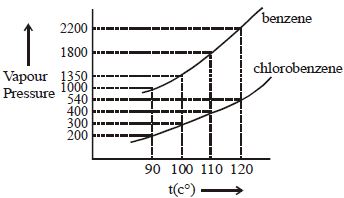
Assuming the formation of an ideal solution, determine the boiling point of a mixture containing $1560\,g$ benzene (molar mass $= 78$) and $1125\,g$ chlorobenzene (molar mass $= 112.5$ ) using the following against an external pressure of $1000\,torr$ .......... $^oC$.
How much faster would a reaction proceed at $25\,^oC$ than at $0\,^oC$ if the activation energy is $65\,kJ$ ....... times
The reaction of chloroform with alcoholic $KOH$ and $p$ -toluidine forms