Question
Test if the following equations are dimensionally correct:

  1. $\text{h}=\frac{2\text{S}\cos\theta}{\rho\text{rg}}$

  2. $\text{u}=\sqrt{\frac{\text{P}}{\rho}}$

  3. $\text{V}=\frac{\pi\text{Pr}^4\text{t}}{8\eta l}$

  4. $\text{v}=\frac{1}{2\pi}\sqrt{\frac{\text{mg}l}{\text{I}}}$

where h = height, S = surface tension, $\rho$ = density, P = pressure, V = volume, $\eta$ = coefficient of viscosity, v = frequency and I = moment of inertia.

Answer

  1. $\text{h}=\frac{2\text{S}\cos\theta}{\rho\text{rg}}$

$\text{LHS}=[\text{L}]$

Surface tension $=\text{S}=\frac{\text{F}}{\text{I}}=\frac{\text{MLT}^{-2}}{\text{L}}=[\text{MT}^{-2}]$

Density $=\rho=\frac{\text{M}}{\text{V}}=[\text{ML}^{-3}\text{T}^{0}]$

Radius $=\text{r}=[\text{L],g = [LT}^{-2}]$

$\text{RHS}=\frac{2\text{S}\cos\theta}{\rho\text{rg}}=\frac{[\text{MT}^{-2}]}{[\text{ML}^{-3}\text{T}^0][\text{L}][\text{LT}^{-2}]}=[\text{M}^0\text{L}^1\text{T}^0]=[\text{L}]$

$\text{LHS = RHS}$

So, the relation is correct

  1. $\text{v}=\sqrt{\frac{\text{P}}{\rho}}$ where v = velocity

$\text{LHS = Dimension of v = [LT}^{-1}]$

Dimension of $\text{p}=\frac{\text{F}}{\text{A}}=[\text{ML}^{-1}\text{T}^{-2}]$

Dimension of $\rho=\frac{\text{m}}{\text{v}} = \text{[ML}^{-2}]$

$\text{RHS}=\sqrt{\frac{\text{p}}{\rho}}=\sqrt{\frac{[\text{ML}^{-1}\text{T}^{-2}]}{[\text{ML}^{-3}]}}=[\text{L}^2\text{T}^{-2}]^{\frac{1}{2}}=[\text{LT}^{-1}]$

So, the relation is correct.

  1. $\text{V}=\frac{(\pi\text{pr}^4\text{t})}{(8\eta\text{I})}$

$\text{LHS = Dimension of V = [L}^3]$

Dimension of $\text{p}=[\text{ML}^{-1}\text{T}^{-2}],\text{r}^4=[\text{L}^4],\text{t}=[\text{T}]$

Coefficient of viscosity $=[\text{ML}^{-1}\text{T}^{-1}]$

$\text{RHS}=\frac{\pi\text{pr}^4\text{t}}{8\eta\text{I}}=\frac{[\text{ML}^{-1}\text{T}^{-2}][\text{L}^4][\text{T}]}{[\text{ML}^{-1}\text{T}^{-1}][\text{L}]}$

So, the relation is correct.

  1. $\text{v}=\frac{1}{2\pi}\sqrt{(\text{mgI}/\text{I})}$

$\text{LHS = dimension of v = [T}^{-1}]$

$\text{RHS}=\sqrt{(\text{mgI}/\text{I})}=\sqrt{\frac{[\text{M}][\text{LT}^{-2}][\text{L}]}{[\text{ML}^2]}}=[\text{T}^{-1}]$

$\text{LHS = RHS}$

So, the relation is correct.
Need a full question paper?

Generate a complete, print-ready paper with questions like this in minutes — across 16+ boards, with answer keys.

Start Generating Free

Similar questions

A metal block of heat capacity 80J°C-1 placed in a room at 20°C is heated electrically. The heater is switched off when the temperature reaches 30°C. The temperature of the block rises at the rate of 2°Cs-1 just after the heater is switched on and falls at the rate of 0.2°Cs-1 just after the heater is switched off. Assume Newton's law of cooling to hold.
  1. Find the power of the heater.
  2. Find the power radiated by the block just after the heater is switched off.
  3. Find the power radiated by the block when the temperature of the block is 25°C.
  4. Assuming that the power radiated at 25°C represents the average value in the heating process, find the time for which the heater was kept on.
0.040g of He is kept in a closed container initially at 100.0°C. The container is now heated. Neglecting the expansion of the container, calculate the temperature at which the internal energy is increased by 12J.
Light of intensity 10–5 W m–2 falls on a sodium photo-cell of surface area 2 cm2. Assuming that the top 5 layers of sodium absorb the incident energy, estimate time required for photoelectric emission in the wave-picture of radiation. The work function for the metal is given to be about 2 eV. What is the implication of your answer?
Consider a non-conducting plate of radius r and mass m that has a charge q distributed uniformly over it. The plate is rotated about its axis with an angular speed $\omega.$ Show that the magnetic moment $\mu$ and the angular momentum of the plate are related as $\mu=\frac{\text{q}}{2\text{m}}\text{l}.$
Assume that a tunnel is dug across the earth (radius = R) passing through its centre. Find the time a particle takes to cover the length of the tunnel if,
  1. It is projected into the tunnel with a speed of $\sqrt{\text{gR}}.$
  2. It is released from a height R above the tunnel.
  3. It is thrown vertically upward along the length of tunnel with a speed of $\sqrt{\text{gR}}.$
Two parallel coaxial circular coils of equal radius ‘R’ and equal number of turns ‘N’, carry equal currents ‘I’ in the same direction and are separated by a distance ‘2R’. Find the magnitude and direction of the net magnetic field produced at the mid-point of the line joining their centres.
Consider the situation of the previous problem. Suppose the block of mass m1 is pulled by a constant force F1 and the other block is pulled by a constant force F2. Find the maximum elongation that the spring will suffer.
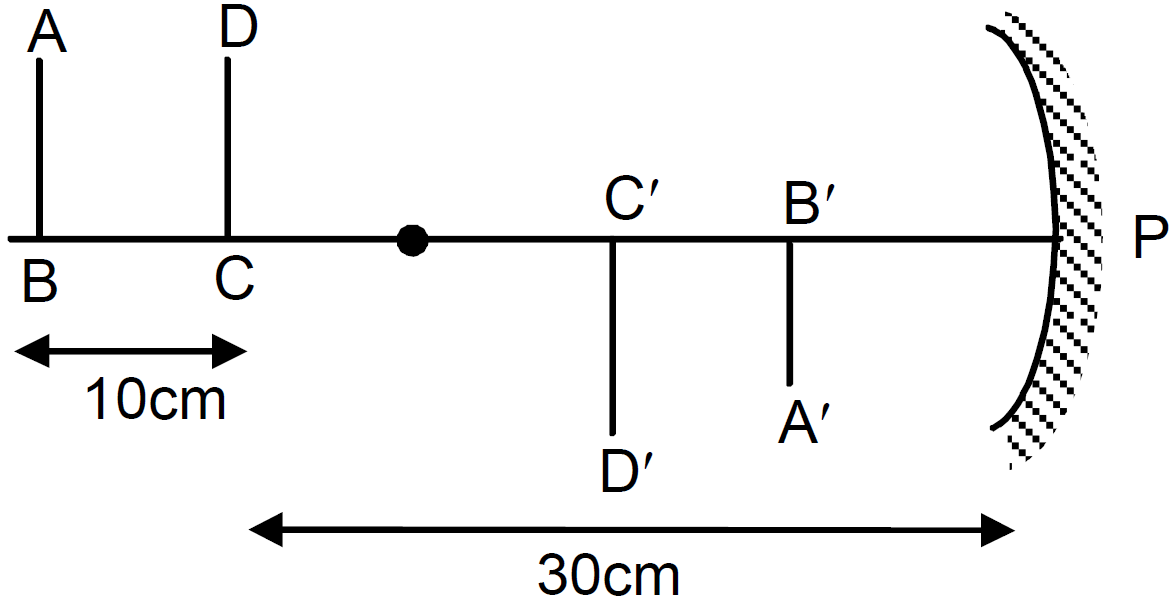
A U-shaped wire is placed before a concave mirror having radius of curvature 20cm. Find the total length of the image.

A turn of radius 20m is banked for the vehicles going at a speed of 36 km/h. If the coefficient of static friction between the road and the tyre is 0.4, what are the possible speeds of a vehicle so that it neither slips down nor skids up?
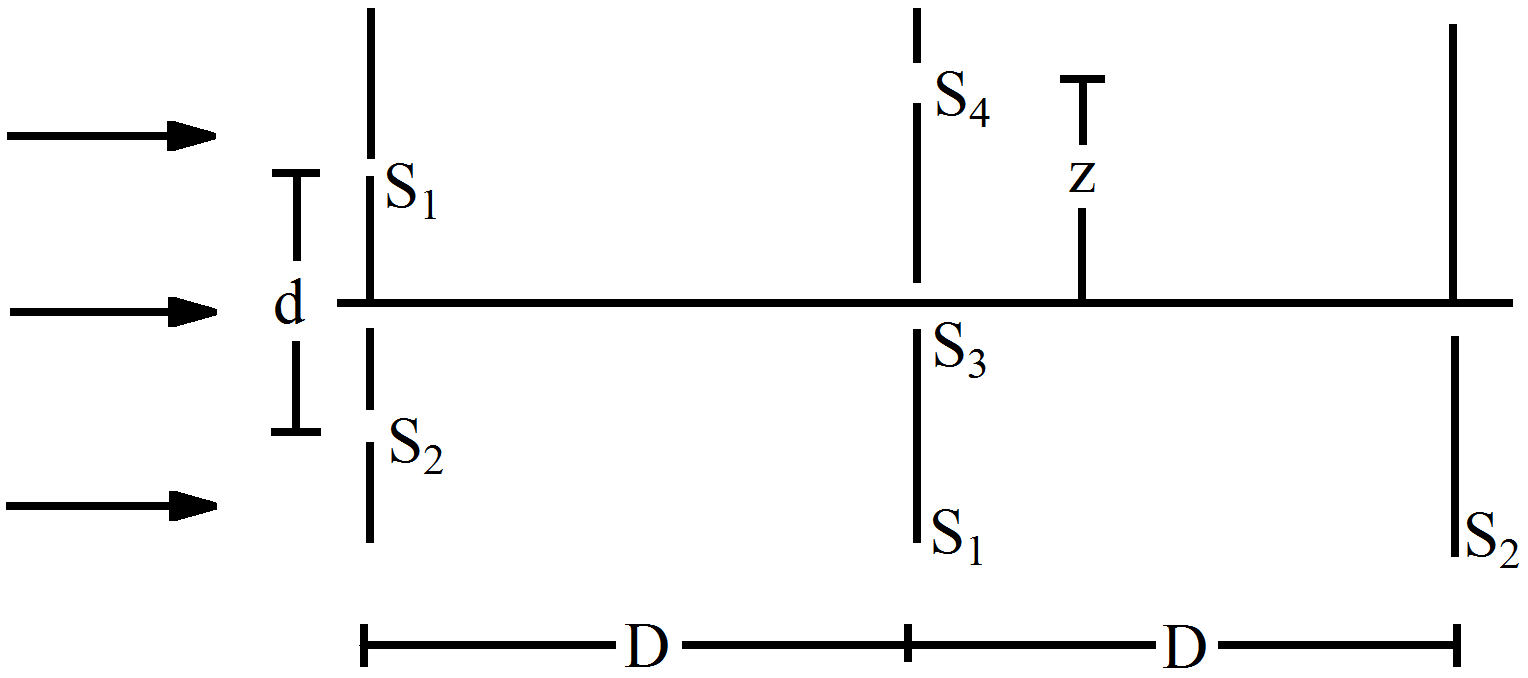
Consider the situation shown in figure (17-E6). The two slits S1 and S2 p laced symmetrically around the central line are illuminated by a monochromatic light of wavelength $\lambda.$ The separation between the slits is d. The light transmitted by the slits falls on a screen E1 placed at a distance D from the slits. The slit S3 is at the central line and the slit S4 is at a distance z from S3. Another
screen $\sum_2$ is placed a further distance D away from $\sum_1$. Find the ratio of the maximum to minimum intensity observed on $\sum_2$, if z is equal to,
  1. $\text{z}=\frac{\lambda\text{D}}{2\text{d}}$
  2. $\frac{\lambda\text{D}}{\text{d}}$
  3. $\frac{\lambda\text{D}}{4\text{d}}$