Question
$\text{ }^{197}_{80}\text{Hg}$ decay to $\text{ }^{197}_{79}\text{Au}$ through electron capture with a decay constant of 0.257 per day.
  1. What other particle or particles are emitted in the decay?
  2. Assume that the electron is captured from the K shell. Use Moseley's law $\sqrt{\text{v}}=\text{a(Z}-\text{b})$ with $\text{a}=4.95\times10^7\text{s}^{-\frac{1}{2}}$ and b = 1 to find the wavelength of the $\text{K}_{\alpha}$ X-ray emitted following the electron capture.
Answer

  1. $\text{P + e}\rightarrow\text{n + v}$ neutrino $\big[\text{a}\rightarrow4.95\times10^7\text{s}^{-\frac{1}{2}};\text{b}\rightarrow1\big]$
  2. $\sqrt{\text{f}}=\text{a(z}-\text{b})$
$\Rightarrow\sqrt{\frac{\text{c}}{\lambda}}=4.95\times10^7(79-1)=4.95\times10^7\times78$

$\Rightarrow\frac{\text{c}}{\lambda}=(4.95\times78)^2\times10^{14}$

$\Rightarrow\lambda=\frac{3\times10^8}{14903.2\times10^{14}}$

$=2\times10^{-5}\times10^{-6}=2\times10^{-4}\text{m}=20\text{pm}$

Need a full question paper?

Generate a complete, print-ready paper with questions like this in minutes — across 16+ boards, with answer keys.

Start Generating Free

Similar questions

The wavelength of light from the spectral emission line of sodium is 589 nm. Find the kinetic energy at which,
  1. An electron, and
  2. A neutron, would have the same de Broglie wavelength.
Two harmonic waves of monochromatic light$\text{y}_{1} = \text{a} \cos\omega\text{t}\text{ and } \text{y}_{2} = \text{a} \cos(\omega\text{t} + \Phi)$
are superimposed on each other. Show that maximum intensity in interference pattern is four times the intensity due to each slit. Hence write the conditions for constructive and destructive interference in terms of the phase angle$\Phi$.
Define the term magnetic inclination. Deduce the relation connecting the horizontal component and inclination with the help of a diagram.
A nearsighted person cannot see beyond 25cm. Assuming that the separation of them glass from the eye is 1cm, find the power of lens needed to see distant objects.
A block at rest explodes into three equal parts. Two parts start moving along X and Y axes respectively with equal speeds of 10m/s. Find the initial velocity of the third part.
A 0.5m long metal rod PQ completes the circuit as shown in the figure. The area of the circuit is perpendicular to the magnetic field of flux density 0.15T. If the resistance of the total circuit is $3\Omega$ calculate the force needed to move the rod in the direction as indicated with a constant speed of $2ms^{-1}.$
What are permanent magnets? What is an efficient way of preparing a permanent magnet? Write two characteristic properties of materials which are required to select them for making permanent magnets.
  1. Draw the energy level diagram showing the emission of b-particles followed by γ-rays by a $\text{ }^{60}_{27}\text{Co}$ nucleus.
  2. Plot of distribution of KE of b-particles is shown in fig. (b).
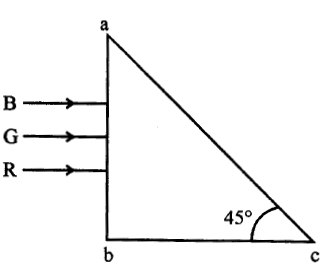
Three light rays red (R), green (G) and blue (B) are incident on a right-angled prism ‘abc’ at face ‘ab’. The refractive indices of the material of the prism for red, green and blue wavelengths are 1.39, 1.44 and 1.47 respectively. Out of the three which colour ray will emerge out of face ‘ac’? Justify your answer. Trace the path of these rays after passing through face ‘ab’.
Calculate the number of photons emitted per second by a 10W sodium vapour lamp. Assume that 60% of the consumed energy is converted into light. Wavelength of sodium light = 590nm.