Question
$\text{Find:}\int \frac{\text{x}\ \text{dx}}{(2 + \text{x}^{\text{2}}) (4 + \text{e}^{4\text{}})}$
Answer

$\text{I} =\frac{1}{2} \int \frac{\text{1}}{\text{(2 + t) (4 +} \text{t}^{2})}\text{dt} \text{ } \text{where} \ \text{t} = \text{x}^2$
$\text{Now},\Bigg[ \frac{1}{\text{(2 + t) (4 + t}^{2})}\Bigg] =\frac{1}{2}\Bigg[ \frac{1}{8 (2 + \text{t})} - \frac{1}{8} \bigg(\frac{\text{t - 2}}{\text{4 + t}^{2}}\bigg)\Bigg]$
$\Rightarrow \int \frac{\text{1}}{\text{(2 + t) (4 + t}^{2})} \text{dt}= \frac{1}{16} \log | \text{2 + t|} = -\frac{1}{32} \log |\text{4 + t}^{2}| + \frac{1}{16} \tan^{-1} \bigg(\frac{\text{t}}{2}\bigg) + \text{c}$
$\Rightarrow \int \frac{\text{x}}{(2 + \text{x}^{\text{2}}) (4 + \text{x}^{4\text{}})}\text{dx} = \frac{1}{16} \log |\text{2 + x}^{\text{2}}| - \frac{1}{32} \log \text{|4 + x}^{\text{4}}| + \frac{1}{16} \tan^{-1} \bigg(\frac{\text{x}^{\text{2}}}{2}\bigg) + \text{c}$

Need a full question paper?

Generate a complete, print-ready paper with questions like this in minutes — across 16+ boards, with answer keys.

Start Generating Free

Similar questions

Let $A =\{1,2,3\}$ and $R =\left( a , b ): a , b \in A\right.$ and $\left|a^2-b^2\right| \leq 5$. Write $R$ as set of ordered pairs. Mention whether $R$ is $i.$ reflexive
$ii$. symmetric
$iii$. transitive
Give reason in each case.
If $\text{x}=\Big(\text{t}+\frac{1}{\text{t}}\Big)^\text{a},\text{y}=\text{a}^{\text{t}+\frac{1}{\text{t}}},$ find $\frac{\text{dy}}{\text{dx}}$
Find the differential equation of all the parabolas with latus rectum '4a' and whose axes are parallel to x-axis.
A fair coin and an unbiased die are tossed. Let $A$ be the event ‘head appears on the coin’ and $B$ be the event $3$ on the die. Check whether $A$ and $B$ are independent events or not.
Evaluate the following integrals:
$\int\frac{1}{\text{x}(\text{x}^6+1)}\text{dx}$
If for function $\phi(\text{x})=\lambda\text{x}^2+7\text{x}-4, \phi(5)=97,$ find $\lambda.$
If R is the largest equivalence relation on a set A and S is any relation on A, then:
  1. $\text{R}\subset\text{S}$
  2. $\text{S}\subset\text{R}$
  3. $\text{R = S}$
  4. None of these.
Show that the following system of linear equation is inconsistent:
x + y − 2z = 5
x − 2y + z = −2
−2x + y + z = 4
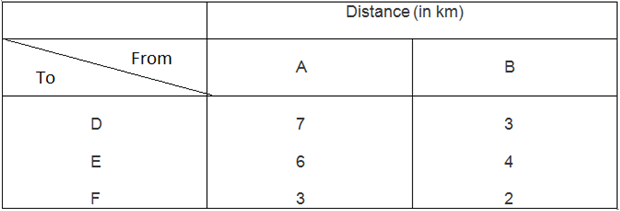
An oil company has two depots, $A$ and $B$, with capacities of $7000$ litres and $4000$  litres respectively. The company is to supply oil to three petrol pumps, $D, E, F$ whose requirements are $4500, 3000$ and $3500$ litres respectively. The distance (in km) between the depots and petrol pumps is given in the following table:

Assuming that the transportation cost per km is Rs. $1.00$ per litre, how should the delivery be scheduled in order that the transportation cost is minimum?
The relation 'R' in N × N such that (a, b)R(c, d) ⇔ a + d = b + c is:
  1. Reflexive but not symmetric.
  2. Reflexive and transitive but not symmetric.
  3. An equivalence relation.
  4. None of the these.