MCQ
$\text{f}(\text{x})=\frac{3\text{x}^2+\text{ax}+\text{a}+1}{\text{x}^2+\text{x}-2}$ and $\lim_\limits{\text{x} \rightarrow -2}\text{f}(\text{x})$ exists. Then the value of $(a - 4)$ is?
  • $9$
  • B
    $10$
  • C
    $11$
  • D
    $12$

Answer

Correct option: A.
$9$
$\text{f}(\text{x})=\frac{3\text{x}^2+\text{ax}+\text{a}+1}{\text{x}^2+\text{x}-2}$
As $0 x \rightarrow -2, D^r\rightarrow 0$.
Hence, as $x \rightarrow -2, N^r\rightarrow 0$.
Therefore, $12 - 2a + a + 1 = 0$ or $a = 13$
Hence, option A is correct.

Need a full question paper?

Generate a complete, print-ready paper with questions like this in minutes — across 16+ boards, with answer keys.
Start Generating Free

Similar questions

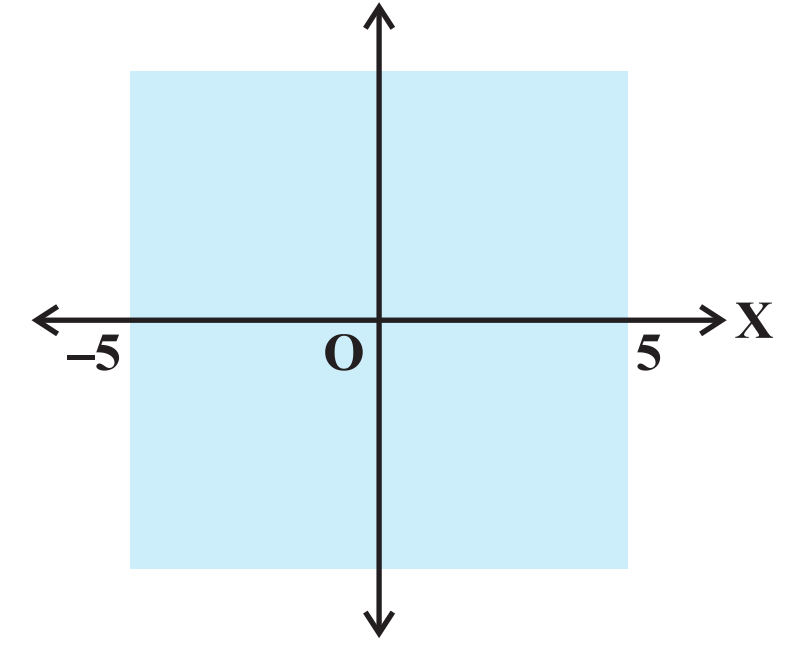
Choose the correct answer. The inequality representing the following graph is:
Choose the correct answer.
The sum of the digits in unit place of all the numbers formed with the help of $3, 4, 5$ and $6$ taken all at a time is.
If the altitudes of a triangle are in $AP,$ then the sides of the triangle are in:
The set $(\text{A} \cap \text{B}')' \cup (\text{B} \cap \text{C})$ is equal to.
If $\sin \theta = - \frac{1}{{\sqrt 2 }}$ and $\tan \theta = 1,$ then $\theta $ lies in which quadrant
Consider the lines given by $ \mathrm{L}_1: \mathrm{x}+3 \mathrm{y}-5=0 $ $ \mathrm{~L}_2: 3 \mathrm{x}-\mathrm{ky}-1=0 $ $ \mathrm{~L}_3: 5 \mathrm{x}+2 \mathrm{y}-12=0$

Match the Statements / Expressions in Column $I$ with the Statements / Expressions in Column $II$ and indicate your answer by darkening the appropriate bubbles in the $4 \times 4$ matrix given in the $ORS.$

Column $I$ Column $II$
$(A)$ $ \mathrm{L}_1, \mathrm{~L}_2, \mathrm{~L}_3$ are concurrent, if $(p)$ $\mathrm{k}=-9$
$(B)$ One of $\mathrm{L}_1, \mathrm{~L}_2, \mathrm{~L}_3$ is parallel to at least one of the other two, if $(q)$ $\mathrm{k}=-\frac{6}{5}$
$(C)$ $\mathrm{L}_1, \mathrm{~L}_2, \mathrm{~L}_3$ form a triangle, if $(r)$ $\mathrm{k}=\frac{5}{6}$
$(D)$ $ \mathrm{L}_1, \mathrm{~L}_2, \mathrm{~L}_3$ do not form a triangle, if $(s)$ $\mathrm{k}=5$
The sum of the series $1^3 + 2^3 + 3^3 + ………..n^3$ is:
The arithmetic mean of first $n$ natural number
Difference between the corresponding roots of ${x^2} + ax + b = 0$ and ${x^2} + bx + a = 0$ is same and $a \ne b$, then
If ${^\text{20}}\text{C}_{3\text{r+1}}={^\text{20}}\text{C}_{\text{r-1}},$ is then $r$ equal to: