Question
$\text{Let}\ \vec{\text{a}}=4\hat{\text{i}}+5\hat{\text{j}}-\hat{\text{k}},\vec{\text{b}}=\hat{\text{i}}-4\hat{\text{j}}+5\hat{\text{k}}$ and $\vec{\text{c}}=3\hat{\text{i}}+\hat{\text{j}}-\hat{\text{k}}$ Find a vector $\vec{\text{d}}$ which is perpendicular to both $\vec{\text{c}}\ \text{and }\vec{\text{b}}\ \text{and}\ \vec{\text{d}}\cdot\vec{\text{a}}=21.$
Answer

$\vec{\text{a}}=4\hat{\text{i}}+5\hat{\text{j}}-\hat{\text{k}}$
$\vec{\text{b}}=-\hat{\text{i}}-4\hat{\text{j}}+5\hat{\text{k}}$
$\vec{\text{c}}=3\hat{\text{i}}+\hat{\text{j}}-\hat{\text{k}}$
To find vector $\vec{\text{d}}$ such that
$\vec{\text{d}}\cdot\vec{\text{c}}=0$
$\vec{\text{d}}\cdot\vec{\text{b}}=0$
$\vec{\text{d}}\cdot\vec{\text{a}}=21$
$\text{Let}\ \vec{\text{d}}=\text{x}\hat{\text{i}}+\text{y}\hat{\text{j}}+\text{z}\hat{\text{k}}$
$\Big(\text{x}\hat{\text{i}}+\text{y}\hat{\text{j}}+\text{z}\hat{\text{k}}\Big)\cdot\Big(3\hat{\text{i}}+\hat{\text{j}}-\hat{\text{k}}\Big)=0$
$3\text{x}+\text{y}-\text{z}=0\ \ \ ....(1)$
$\Big(\text{x}\hat{\text{i}}+\text{y}\hat{\text{j}}+\text{z}\hat{\text{k}}\Big)\cdot\Big(\hat{\text{i}}+5\hat{\text{j}}-\hat{\text{k}}\Big)=0$
$\text{x}-4\text{y}+5\text{z}=0\ \ \ ....(2)$
$\Big(\text{x}\hat{\text{i}}+\text{y}\hat{\text{j}}+\text{z}\hat{\text{k}}\Big)\cdot\Big(4\hat{\text{i}}+5\hat{\text{j}}-\hat{\text{k}}\Big)=21$
$4\text{x}+5\text{y}-\text{z}=21\ \ \ ....(3)$
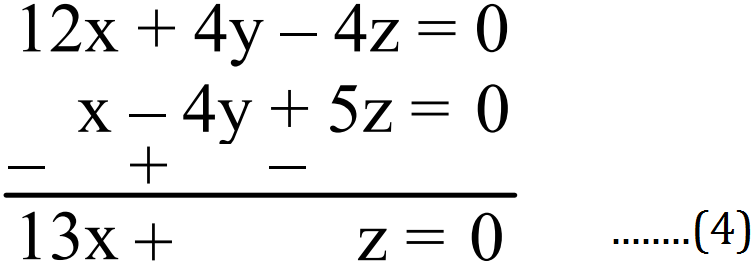
$\text{eq}^\text{n}(1)\times4+\text{eq}^\text{n}(2)$

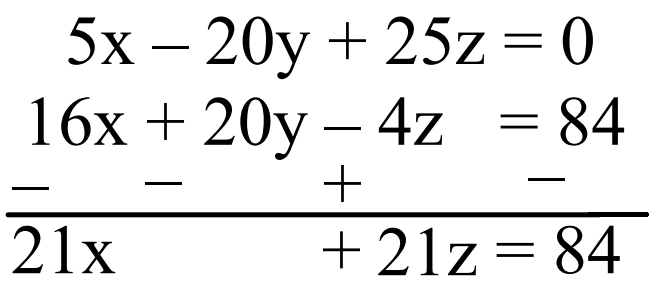
$\text{eq}^\text{n}(2)\times5+\text{eq}^\text{n}(3)\times4$

$21(\text{x}+\text{z})=84$
$\text{x}+\text{z}=4\ \ \ ....(5)$
$\text{eq}.(4)-(5)$
$12\text{x}=-4$
$\text{x}=\frac{-4}{12}=\frac{-1}{3}$
$\text{z}=4-\text{x}$
$\text{z}=4+\frac{1}{3}=\frac{13}{3}$
$\text{Put x}\ \&\ \text{z in }(1)$
$3\text{x}+\text{y}-\text{z}=0$
$3\times\Big(\frac{-1}{3}\Big)+\text{y}-\frac{13}{3}=0$
$\text{y}=\frac{13}{3}+1$
$\text{y}=\frac{16}{3}$
$\vec{\text{d}}=\text{x}\hat{\text{i}}+\text{y}\hat{\text{j}}+\text{z}\hat{\text{k}}$
$\vec{\text{d}}=\frac{-1}{3}\hat{\text{i}}+\frac{16}{3}\hat{\text{j}}+\frac{13}{3}\hat{\text{k}}$

Need a full question paper?

Generate a complete, print-ready paper with questions like this in minutes — across 16+ boards, with answer keys.

Start Generating Free

Similar questions

Prove that the line $\vec{\text{r}}=\big(\hat{\text{i}}+\hat{\text{j}}-\hat{\text{k}}\big)+\lambda\big(3\hat{\text{i}}-\hat{\text{j}}\big)$ and $\vec{\text{r}}=\big(4\hat{\text{i}}-\hat{\text{k}}\big)+\mu\big(2\hat{\text{i}}+3\hat{\text{k}}\big)$ intersect and find their point of intersection.
Solve the following differential equation
$\sin^4\text{x}\frac{\text{dy}}{\text{dx}}=\cos\text{x}$
Show that the lines $\frac{\text{x}+4}{3}=\frac{\text{y}+6}{5}=\frac{\text{z}-1}{-2}$ and 3x - 2y + z + 5 = 0 = 2x + 3y + 4z - 4 intersect. Find the equation of the plane in which they lie and also their of intersection.
Find the intervals in which the following functions are increasing or decreasing.
$\text{f}(\text{x})=\frac{3}{10}\text{x}^4-\frac{4}{5}\text{x}^3-3\text{x}^2+\frac{36}{5}\text{x}+11$
Let $\text{F}(\alpha)=\begin{bmatrix}\cos\alpha & -\sin\alpha & 0 \\ \sin\alpha & \cos\alpha & 0 \\ 0 & 0 & 1\end{bmatrix}$
$\text{and G }(\beta)=\begin{bmatrix} \cos\beta & 0 & \sin\beta \\ 0 & 1 & 0 \\ -\sin\beta & 0 & \cos\beta \end{bmatrix}$
Show that
$\big[\text{F}(\alpha)\text{G}(\beta)\big]^{-1}=\text{G}(-\beta)\text{F}(-\alpha).$
Find the equation of the perpendicular drawn from the point P(-1, 3, 2) to the line $\vec{\text{r}}=\big(2\hat{\text{j}}+3\hat{\text{k}}\big)+\lambda\big(2\hat{\text{i}}+\hat{\text{j}}+3\hat{\text{k}}\big).$ Also, find the coordinates of the foot of the perpendicular from P.
Show that the points whose position vectors are$\vec{\text{a}}=4\hat{\text{i}}-3\hat{\text{j}}+\hat{\text{k}}, \vec{\text{b}}=2\hat{\text{i}}-4\hat{\text{j}}+5\hat{\text{k}},\vec{\text{c}}=\hat{\text{i}}-\hat{\text{j}}$ from a right triangle.
Find the area of region bounded by the line $x = 2$ and the parabola $y^2 = 8x$.
Differentiate the following functions with respect to x:
$\log\sqrt{\frac{1-\cos\text{x}}{1+\cos\text{x}}}$
Find the equation of line passing through the point A(0, 6, -9) and B(-3, -6, 3). If D is the foot of perpendicular drawn from a point C(7, 4, -1) on the line AB, then find the coordiantes of the point D and the equation of line CD.