Question
$\frac{\text{x}}{2}+\frac{\text{x}}{8}=\frac{1}{8}$

Answer

$\frac{\text{x}}{2}+\frac{\text{x}}{8}=\frac{1}{8}$
$\frac{4\text{x}+\text{x}}{8}=\frac{1}{8}$ $(L.C.M$ of $2, 8 = 8)$
$\frac{5\text{x}}{8}=\frac{1}{8}$
Dividing by $\frac{5}{8}$
$\frac{5}{8}\text{x}​+\frac{5}{8}=​​​​\frac{1}{8}+\frac{5}{8}$
$\Rightarrow\frac{5}{8}\text{x}​\times\frac{8}{5}=​​\frac{1}{8}\times\frac{5}{8}$
$\Rightarrow\text{x}=\frac{1}{5}$
$\therefore\text{x}=\frac{1}{5}$
Verification:
$\text{L.H.S}$ $=\frac{\text{x}}{2}+\frac{\text{x}}{8}$
$=\frac{\frac{1}{5}}{2}+\frac{\frac{1}{5}}{8}=\frac{1}{5\times2}+\frac{1}{5\times8}$
$=\frac{1}{10}+\frac{1}{40}=\frac{4+1}{40}=\frac{5}{40}$
$=\frac{1}{8}=\text{R.H.S}$

Need a full question paper?

Generate a complete, print-ready paper with questions like this in minutes — across 16+ boards, with answer keys.
Start Generating Free

Similar questions

Multiply the following :
$\left(\frac{3}{2} p^2+\frac{2}{3} q^2\right),\left(2 p^2-3 q^2\right)$
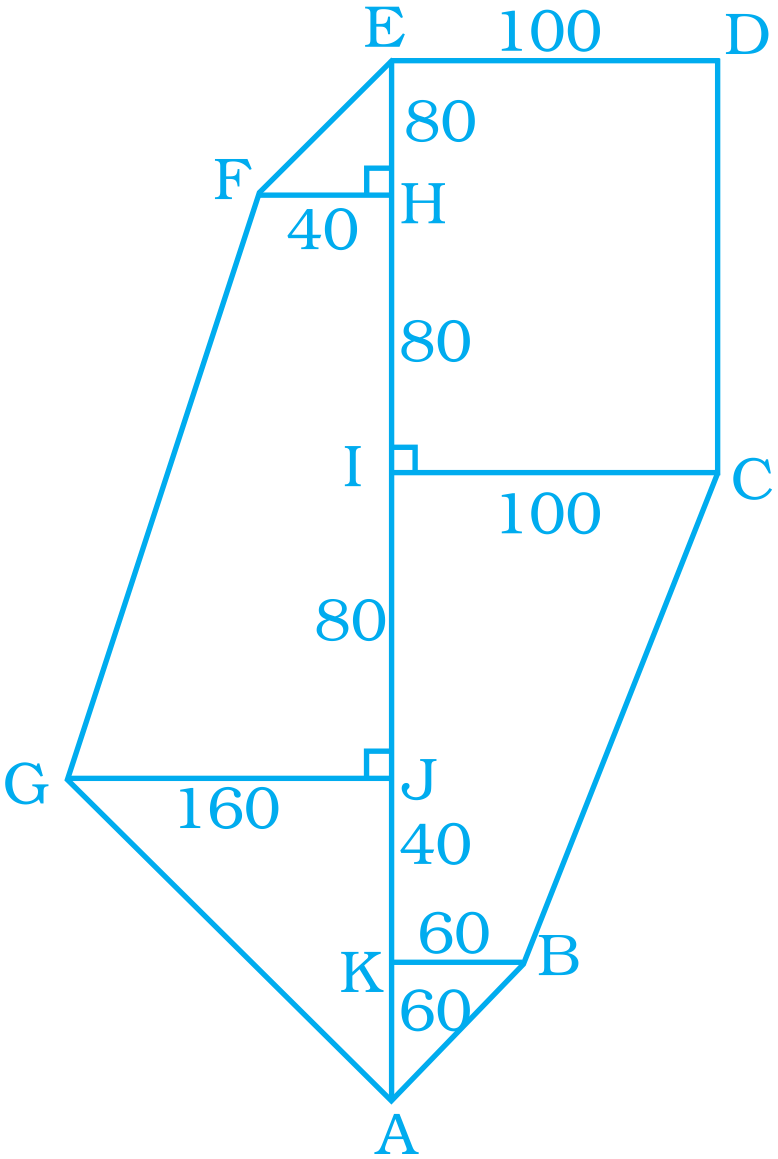
Find the area of the following fields. All dimensions are in metres.
Simple interest on a sum of money for $2$ years at $6\frac{1}{2}\%$ per annum is $Rs. 5200$. What will be the compound interest on the sum at the same rate for the same period?
Diagonals of parallelogram $\text{ABCD}$ intersect at $O$ as shown in the figure. $\text{XY}$ contains $O$, and $\text{X, Y}$ are points on opposite sides of the parallelogram. Give reasons for each of the following:
$i. \text{OB}=\text{OD}$
$ii. \angle\text{OBY}=\angle\text{ ODX}$
$iii. \angle\text{BOY}=\angle\text{DOX}$
$iv. \triangle\text{BOY}=\triangle\text{DOX}$
Now, state if $\text{XY}$ is bisected at $O$.
Find the area of a quadrilateral one of whose diagonals is $40\ cm$ and the lengths of the perpendiculars drawn from the opposite vertices on the diagonal are $16\ cm$ and $12\ cm.$
Draw a pie-diagram of the areas of continents of the world given in the following table:
Continents
Asia
U.S.S.R
Africa
Europe
Noth America
South America
Australia
Area (in million sq.km)
$26.9$
$20.5$
$30.3$
$4.9$
$24.3$
$17.9$
$8.5$
The four angles of a quadrilateral are as $3 : 5 : 7 : 9$. Find the angles.
In a television game show, the prize money of ₹ 100000 is to be divided equally amongst the winners. Complete the following table and find whether the prize money given to an individual winner is directly or inversely proportional to the number of winners?
Number of winnersPrize for each winner (in ₹)
1100000
250000
4
5
8
10
20
Deepak claims, “There are some multiples of 11 which, when doubled, are still multiples of 11. But other multiples of 11 don’t remain multiples of 11 when doubled”. Examine if his conjecture is true; explain your conclusion.
Ravish has three boxes whose total weight is $60\frac{1}{2}$ $kg$. Box $B$ weighs $3\frac{1}{2}$ $kg$. more then box $A$ and box $C$ weighs $5\frac{1}{3}$ $kg$. more than box $B$. Find the weight of box $A$.