Question
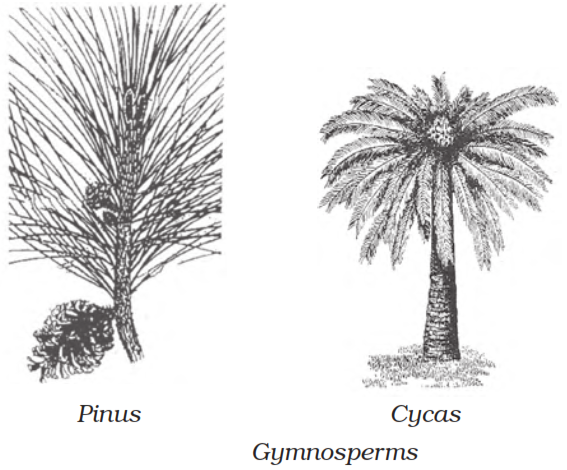
Thallophyta, bryophyta and pteridophyta are called as ‘Cryptogams’. Gymnosperms and Angiosperms are called as ‘phanerogams’. Discuss why? Draw one example of Gymnosperm.
Answer


Thallophyta, bryophyta and pteridophyta are called as ‘Cryptogams’ because the reproductive organs of these groups are inconspicuous or hidden. Seeds and flowers are absent. On the other hand ‘Phanerogams’ include gymnosperms and angiosperms which have well differentiated reproductive tissues and the embryo with stored food. Flowers and seeds are present in phanerogams.

Need a full question paper?

Generate a complete, print-ready paper with questions like this in minutes — across 16+ boards, with answer keys.

Start Generating Free

Similar questions

Draw a labelled diagram to show nitrogen cycle in nature.
Obtain a relation for the distance travelled by an object moving with a uniform acceleration in the interval between 4th and 5th seconds.
Explain the role of workers in a bee colony.
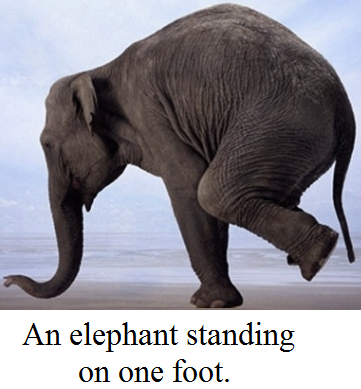
An elephant weighing $40,000N$ stands on one foot of area $1000cm^2$ whereas a girl weighing $400N$ is standing on one ‘stiletto’ heel of are

a $1cm^2.$
  1. Which of the two, elephant or girl, exerts a larger force on the ground and by how much?
  2. What pressure is exerted on the ground by the elephant standing on one foot?
  3. What pressure is exerted on the ground by the girl standing on one heel?
  4. Which of the two exerts larger pressure on the ground: elephant or girl?
  5. What is the ratio of pressure exerted by the girl to the pressure exerted by the elephant?
What mass of nitrogen $N_2$, will contain the same number of molecules as $1.8g$ of water, $H_2O$? (Atomic masses: $N = 14u; H = 1u; O = 16u$)
What are differences between the following: Cartilaginous fishes and bony fishes.
How bee colony works? What values can be seen in the organization of bee colony?
The atom of an element $X$ has $7$ electrons in its $M$ shell:
  1. Write the electronic configuration of element $X$.
  2. What is the atomic number of element $X$?
  3. Is it a metal or a non-metal?
  4. What type of ion will be formed by an atom of element $X$? Write the symbol of the ion formed.
  5. What could element $X$ be?
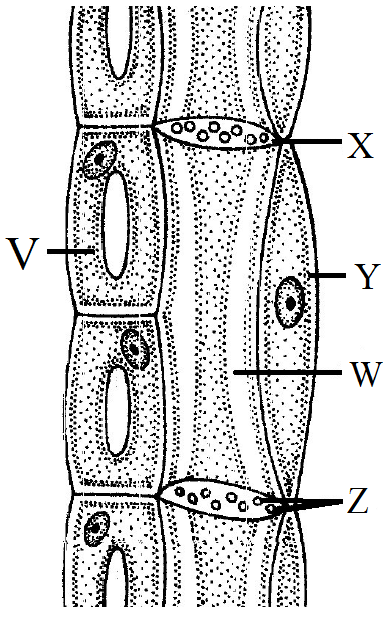
  1. Identify the figure. What is its function$?$
  2. Label $V$ and $W.$
  3. Label $X, Y$ and $Z.$
  4. W loses its nucleus in the mature state, still it remains alive. Explain how$?$
What are the advantages of classifying organisms?