MCQ
That gas cannot be liquified
  • A
    Which obeys Vander Waal's equation
  • Which obeys gas equation at every temperature and pressure
  • C
    The molecules of which are having potential energy
  • D
    Which is a inert gas

Answer

Correct option: B.
Which obeys gas equation at every temperature and pressure
b
An ideal gas can never be liquified because the intermelecular forces of attraction among the ideal gas molecules are negligible. Intermolecular forces are Zero for an ideal gas.

Correct choice - option $B$

Need a full question paper?

Generate a complete, print-ready paper with questions like this in minutes — across 16+ boards, with answer keys.
Start Generating Free

Similar questions

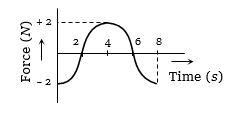
The force-time $(F -t) $ curve of a particle executing linear motion is as shown in the figure. The momentum acquired by the particle in time interval from zero to $8$ second will be  ........... $N-s$
A car moves with speed $60 \,km / h$ for $1$ hour in east direction and with same speed for $30$ min in south direction. The displacement of car from initial position is ......... $km$
Consider a car moving on a straight road with a speed of $100\, m/s$. The distance at which car can be stopped, is ........ $m$. $[\mu_k = 0.5]$
The breaking stress of a wire depends on:
  1. Material of the wire.
  2. Length of the wire.
  3. Radius of the wire.
  4. Shape of the cross-section.
A constant force acts on a body. Which of the following correctly represents the variation of the power $P$ developed with time $t$?
Let An be the area enclosed by the nth orbit in a hydrogen atom. The graph of ln $\Big(\frac{\text{A}_\text{n}}{\text{A}_1}\Big)$ against in(n):
  1. Will pass through the origin.
  2. Will be a straight line with slope 4.
  3. Will be a monotonically increasing nonlinear curve.
  4. Will be a circle.
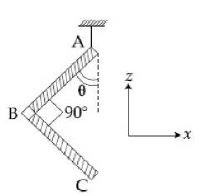
An $L-$ shaped object, made of thin rods of uniform mass density, is suspended with a string as shown in figure. If $AB = BC$, and the angle made by $AB$ with downward vertical is $\theta$ then
A machine gun of mass $10\,kg$ fires $20\,g$ bullets at the rate of $180$ bullets per minute with a speed of $100\,m s ^{-1}$ each. The recoil velocity of the gun is $.............\,m/s$
prism can produce a minimum deviation $\delta$ in a light beam. If three such prisms are combined, the minimum deviation that can be produced in this beam is:

  1. $0$

  2. $\delta$

  3. $2\delta$

  4. $3\delta$

Starting from the origin a body oscillates simple harmonically with a period of $2\ s$. After what time will its kinetic energy be $75\%$ of the total energy?