MCQ
That part of electromagnetic spectrum which is used to study crystal structure is:
  • A
    Micro waves
  • B
    Radio waves
  • X-rays
  • D
    Infrared rays

Answer

Correct option: C.
X-rays
(c)X-rays

Need a full question paper?

Generate a complete, print-ready paper with questions like this in minutes — across 16+ boards, with answer keys.
Start Generating Free

Similar questions

When the object is at distances $u_1$ and $u_2$ the images formed by the same lens are real and virtual respectively and of the same size. Then focal length of the lens is :
Ratio of amplitude of interfering waves is $3 : 4$. Now ratio of their intensities will be
Magnetic flux $\phi ($in weber$)$ linked with a closed circuit of resistance $10\Omega$ varies with time $t ($in second$)$ as $\phi=512-4\text{t}+1$.The induced electromotive force in the circuit at $t = 0.2$ second is.
A small bar magnet A oscillates in a horizontal plane with a period T at a place where the angle of dip is 60$^\circ$. When the same needle is made to oscillate in a vertical plane coinciding with the magnetic meridian, its period will be
A singly ionised helium atom in an excited state $(n=4)$ emits a photon of energy $2.6 \,eV$. Given that the ground state energy of hydrogen atom is $-13.6 \,eV$, the energy $E_f$ and quantum number $n$ of the resulting state are respectively,
Radioactive nuclei that are injected into a patient collect at certain sites within its body, undergoing radioactive decay and emitting electromagnetic radiation. These radiations can then be recorded by a detector. This procedure provides an important diagnostic tool called
What is the total charge on the parallel plate capacitor shown?
Image
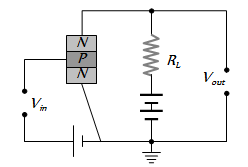
An NPN-transistor circuit is arranged as shown in figure. It is
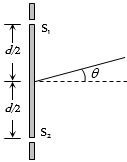
In an interference arrangement similar to Young's double slit experiment, the slits $S_1$ and $S_2$ are illuminated with coherent microwave sources each of frequency $10^6 Hz$. The sources are synchronized to have zero phase difference. The slits are separated by distance $d = 150\, m$. The intensity I$(\theta )$is measured as a function of $\theta$, where $\theta$ is defined as shown. If $I_0$ is maximum intensity, then $I(\theta )$ for $0 \le \theta \le {90^o}$is given by
To deposit one gm equivalent of an element at an electrode, the quantity of electricity needed is