MCQ
The above reaction completes with the mechanism
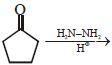
- ANucleophilic substitution -elimination mechanism
- BElectrophilic addition -elimination mechanism
- CElectrophilic substituion -elimination mechanism
- ✓Nucleophilic addition -elimination mechanism
Generate a complete, print-ready paper with questions like this in minutes — across 16+ boards, with answer keys.
$[i.e.\, \Lambda ^o_{m(NH_4OH)}]$ is equal to
[Use : $\left.\mathrm{h}=6.63 \times 10^{-34}\, \mathrm{Js}, \mathrm{m}_{\mathrm{e}}=9.0 \times 10^{-31}\, \mathrm{~kg}\right]$
$A \to {\text{Product ;}}\,\, - \frac{{d[A]}}{{dt}} = {k_1}{[A]^o}$
$B \to {\text{Product ;}}\,\, - \frac{{d[B]}}{{dt}} = {k_2}{[B]}$
Units of $k_1$ and $k_2$ are expressed in terms of molarity $(M)$ and time $(sec^{-1})$ as
$(I)$ $ Ph -COCH_3$
$(II)$ $CH_3 -CO -CH_3$
$(III)$ $CH_3 -CHO$
$(IV)$ $Ph -COCH_2 -CH_3$