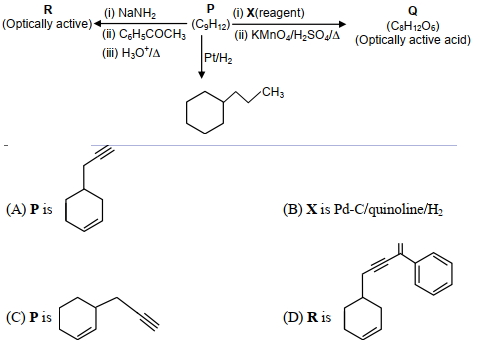
Question
The absolute configuration of
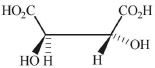
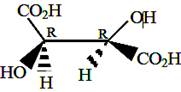
Answer

b

Need a full question paper?

Generate a complete, print-ready paper with questions like this in minutes — across 16+ boards, with answer keys.

Start Generating Free

Similar questions

the heat of combustion of carbon monoxide at constant volume and at ${17\,^o}C$ is $-283.3 \,kJ$ , then its heat of combustion at constant pressure.....$kJ$

$(R = 8.314\,J\,{\rm{degre}}{{\rm{e}}^{{\rm{ - 1}}}}mo{l^{ - 1}})$

$28.0\,L$ of $CO _2$ is produced on complete combustion of $16.8\,L$ gaseous mixture of ethene and methane at $25^{\circ}\,C$ and $1\,atm$. Heat evolved during the combustion process is $.........\,kJ$.Given : $\Delta H _{ C }\left( CH _4\right)=-900\,kJ\,mol ^{-1}$ $\Delta H _{ C }\left( C _2 H _4\right)=-1400\,kJ\,mol ^{-1}$
The e.m.f. of the cell in which the following reaction

$Zn(s) + N{i^{2 + }}(a = 1.0)$ $\rightleftharpoons$ $Z{n^{2 + }}(a = 10) + Ni(s)$ occurs, is found to be $0.5105\,V$ at $298\,K$. The standard e.m.f. of the cell is ............ $\mathrm{V}$

$2.2\, g$ of nitrous oxide $\left( N _{2} O \right)$ gas is cooled at a constant pressure of $1\, atm$ from $310\, K$ to $270 \,K$ causing the compression of the gas from $217.1 \,mL$ to $167.75 \,mL$. The change in internal energy of the process, $\Delta U$ is ' $- x ^{\prime} J$. The value of ' $x$ ' is $....$

[nearest integer]

(Given: atomic mass of $N =14\, g \,mol ^{-1}$ and of $O$ $=16\, g\, mol ^{-1}$.

Molar heat capacity of $N _{2} O$ is $100\, JK ^{-1}\, mol ^{-1}$ )

Which of the following ketone will NOT give enamine on treatment with secondary amines?
Reaction between acetone and methylmagnesium chloride followed by hydrolysis will give :
Bohr’s model can not explain the emission spectrum of
How many of the following orders of covalent characters are $TRUE$

$(i)\, LiF > LiCl > LiBr > LiI$
$(ii)\, CaCl_2 < FeCl_2 < FeCl_3$
$(iii)Hg_2Cl_2 > HgCl_2$
$(iv)\, ZnCl_2 < CdCl_2 < HgCl_2$
$(v) CuCl < AgCl < AuCl$
$(vi) AlN > Al_2O_3 > AlF_3$
$(vii) CaF_2 < CaCl_2 < CaBr_2 < CaI_2$
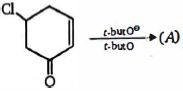
$"(A)"$ is
Consider the following transformations of a compound $P$.

(image)

Choose the correct option($s$).

(image)