MCQ
The absolute zero is the temperature at which
  • A
    Water freezes
  • B
    All substances exist in solid state
  • Molecular motion ceases
  • D
    None of the above

Answer

Correct option: C.
Molecular motion ceases
c
(c)At absolute zero $($i.e. $0 \,K)$ $v_{rms}$ becomes zero.

Need a full question paper?

Generate a complete, print-ready paper with questions like this in minutes — across 16+ boards, with answer keys.
Start Generating Free

Similar questions

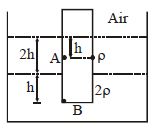
A cylinder stands vertical in two immiscible liquids of densities $\rho$ and $2 \rho$. The height of two liquids are shown. Find the difference in pressure at point $A$ and $B$
For ordinary terrestrial experiments, which of the following observers below are inertial.
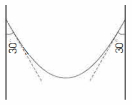
A rope of mass $5 \,kg$ is hanging between two supports as shown alongside. The tension at the lowest point of the rope is close to ........... $N$ (take, $g=10 \,m / s ^{2}$ )
Cooling rate of a sphere of $600\,K$ at external environment $(200\,K)$ is $R$ . When the temperature of sphere is reduced to $400\,K$ then cooling rate of the sphere becomes
A bullet is fired from a cannon with velocity $500 \,m/s$. If the angle of projection is ${15^o}$ and $g = 10m/{s^2}$. Then the range is
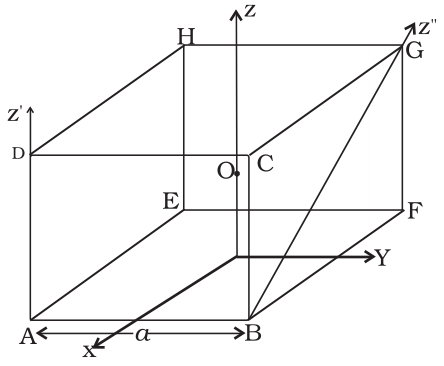
With reference to of a cube of edge a and mass m, state whether the following are true or false. (O is the centre of the cube.)

When temperature increase then frequency of organ pipe.
For a diatomic gas change in internal energy for unit change in temperature for constant pressure and constant volume is ${U_1}$ and ${U_2}$ respectively. ${U_1}:{U_2}$ is
A container with $1 kg$ of water in it is kept in sunlight, which causes the water to get warmer than the surroundings. The average energy per unit time per unit area received due to the sunlight is $700 Wm ^{-2}$ and it is absorbed by the water over an effective area of $0.05 m ^2$. Assuming that the heat loss from the water to the surroundings is governed by Newton's law of cooling, the difference (in ${ }^{\circ} C$ ) in the temperature of water and the surroundings after a long time will be. . . . . . . . (Ignore effect of the container, and take constant for Newton's law of cooling $=0.001 s ^{-1}$, Heat capacity of water $\left.=4200 J kg ^{-1} K ^{-1}\right)$
At constant pressure, the volume of the gas is proportional to the absolute temperature is called as: