The acceleration due to gravity at a place is ${\pi ^2}\,m/se{c^2}$. Then the time period of a simple pendulum of length one metre is
Easy
Download our app for free and get started
$T = 2\pi \sqrt {\frac{l}{g}} = 2\pi \sqrt {\frac{1}{{{\pi ^2}}}} = 2 \,sec$

Download our appand get started for free
Experience the future of education. Simply download our apps or reach out to us for more information. Let's shape the future of learning together!No signup needed.*
Similar Questions
- 1A simple harmonic oscillator has a period of $0.01 \,sec$ and an amplitude of $0.2\, m$. The magnitude of the velocity in $m{\sec ^{ - 1}}$ at the centre of oscillation isView Solution
- 2On a planet a freely falling body takes $2 \,sec$ when it is dropped from a height of $8 \,m$, the time period of simple pendulum of length $1\, m$ on that planet is ..... $\sec$View Solution
- 3A particle moves with simple harmonic motion in a straight line. In first $\tau \,s$, after starting from rest, it travels a distance $a$, and in next $\tau \,s$, it travels $2a$ in same direction thenView Solution
- 4A particle moves on $x-$ axis according to the equation $x = x_0\,\,sin^2\,\omega t,$ the motion is simple harmonicView Solution
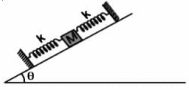
- 5View SolutionIn the adjacent figure, if the incline plane is smooth and the springs are identical, then the period of oscillation of this body is
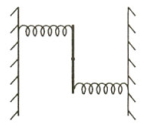
- 6A uniform rod of length $L$ and mass $M$ is pivoted at the centre. Its two ends are attached to two springs of equal spring constants $k$. The springs are fixed to rigid supports as shown in the figure, and the rod is free to oscillate in the horizontal plane. The rod is gently pushed through a small angle $\theta$ in one direction and released. The frequency of oscillation isView Solution
- 7The amplitude of the vibrating particle due to superposition of two $SHMs,$View Solution
$y_1 = \sin \left( {\omega t + \frac{\pi }{3}} \right)$ and $y_2 = \sin \omega t$ is :
- 8A second's pendulum is placed in a space laboratory orbiting around the earth at a height $3R$, where $R$ is the radius of the earth. The time period of the pendulum isView Solution
- 9$2$ particles $p$ and $q$ describe $SHM$ of same amplitude $a$ and same frequency $f$ along straight line, the maximum distance between the two particle $a\sqrt 2 $ . The initial phase difference between particle isView Solution
- 10A particle of mass $m$ is located in a one dimensional potential field where potential energy is given by : $V(x) = A(1 -cos\, px)$ ,View Solution
where $A$ and $p$ are constant.
The period of small oscillations of the particle is