MCQ
The acceleration due to gravity at pole and equator can be related as
  • A
    ${g_p} < {g_e}$
  • B
    ${g_p} = {g_e} = g$
  • C
    ${g_p} = {g_e} < g$
  • ${g_p} > {g_e}$

Answer

Correct option: D.
${g_p} > {g_e}$
d
(d)

Need a full question paper?

Generate a complete, print-ready paper with questions like this in minutes — across 16+ boards, with answer keys.
Start Generating Free

Similar questions

The potential energy of a particle of mass $1\, kg$ in motion along the $x-$ axis is given by $U = 4\,(1 -cos\,2x)$, where $x$ is in $metres$ . The period of small oscillation (in $second$ ) is
A fighter plane is flying horizontally at a height of $250\  m$ from ground with constant velocity of $500\  m/s$. It passes exactly over a cannon which can fire a shell at any time in any direction with a speed of  $100\  m/s$. Find the duration of time  for which the plane is in danger of being hit by a cannon shell
A wide vessel with a small hole at the bottom is filled with two liquids. The density and heightof one liquid are $\rho_1$ and $h_1$ and that of the otherare  $\rho_2$ and $h_2 \ (\rho_1 >\rho_2)$. The velocity of liquid coming out of the hole is :
The masses and radii of the earth and the moon are $M_1$, $R_1$ and $M_2$,$R_2$ respectively. Their centres are distance $d$ apart. The minimum speed with which particle of mass m should be projected from a point midway between the two centres so as to escape to infinity is :
A force of $50$ dynes is acted on a body of mass $5$ g which is at rest for an interval of $3$ seconds, then impulse is
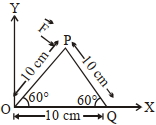
A triangular plate is shown. A force $\overrightarrow{ F }=4 \hat{ i }-3 \hat{ j }$ is applied at point $P$. The torque at point $P$ with respect to point $'O'$ and $'Q'$ are
The moment of inertia of a body depends on
The horizontal range and the maximum height of a projectile are equal . The angle of projection of the projectile is
Let $\vec{\text{F}}$ be a force acting on a particle having position vector $\vec{\text{r}}.$ Let $\vec{\tau}$ be the torque of this force about the origin, then:

  1. $\vec{\text{r}}.\vec{\text{F}}=0$ and $\vec{\text{F}}.\vec{\tau}=0$

  2. $\vec{\text{r}}.\vec{\tau}=0$ but $\vec{\text{F}}.\vec{\tau}\neq0$

  3. $\vec{\text{r}}.\vec{\tau}\neq0$ but $\vec{\text{F}}.\vec{\tau}=0$

  4. $\vec{\text{r}}.\vec{\tau}\neq0$ and $\vec{\text{F}}.\vec{\tau}\neq0$

If a rubber ball falls from a height $h$ and rebounds upto the height of $h / 2$. The percentage loss of total energy of the initial system as well as velocity ball before it strikes the ground, respectively, are :