MCQ
The addition of $HBr$ is easiest with
- A$ClC{H_2} = CHCl$
- B$ClCH = CHCl$
- C$C{H_3} - CH = C{H_2}$
- ✓${(C{H_3})_2}C = C{H_2}$
Generate a complete, print-ready paper with questions like this in minutes — across 16+ boards, with answer keys.
$ NH_3(g) \rightleftharpoons \frac{1}{2}\,{N_2}\left( g \right) + \frac{3}{2}{H_2}\left( g \right);\,{K_2}$
$\frac{1}{2}\,{N_2}\left( g \right) + \frac{3}{2}{H_2}\left( g \right) \rightleftharpoons NH_3(g); K_3$
$2NH_3(g) \rightleftharpoons N_2(g) + 3H_2(g); K_4$
If $K_1 = K_2^x = K_3^y = K_4^z$ then correct values of $x, y$ and $z$ are respectively
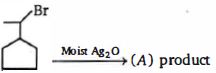
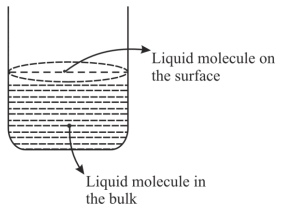
$A.$ Surface tension is the outcome of equal attractive and repulsion forces acting on the liquid molecule in bulk.
$B.$ Surface tension is due to uneven forces acting on the molecules present on the surface.
$C.$ The molecule in the bulk can never come to the liquid surface.
$D.$ The molecules on the surface are responsible for vapour pressure if the system is a closed system.