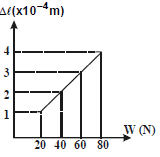
The adjacent graph shows the extension $(\Delta l)$ of a wire of length $1\, m$ suspended from the top of a roof at one end and with a load $W$ connected to the other end. If the cross-sectional area of the wire is $10^{-6}\, m^2$, calculate the Young’s modulus of the material of the wire.
AIIMS 2008, Medium


Download our appand get started for free
Experience the future of education. Simply download our apps or reach out to us for more information. Let's shape the future of learning together!No signup needed.*
Similar Questions
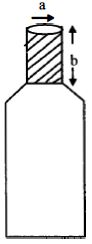
- 1A bottle has an opening of radius $a$ and length $b$. A cork of length band radius $\left( {a + \Delta a} \right)$ where $\left( {\Delta a < < a} \right)$ is compressed to fit into the opening completely (see figure). If the bulk modulus of cork is $B$ and frictional coefficient between the bottle and cork is $\mu $ then the force needed to push the cork into the bottle isView Solution
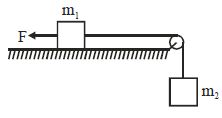
- 2Consider the situation shown in figure. The force $F$ is equal to the $m_2g/2.$ If the area of cross-section of the string is $A$ and its Young's modulus $Y$, find the strain developed in it. The string is light and there is no friction anywhereView Solution
- 3The density and breaking stress of a wire are $6 \times$ $10^4 \mathrm{~kg} / \mathrm{m}^3$ and $1.2 \times 10^8 \mathrm{~N} / \mathrm{m}^2$ respectively. The wire is suspended from a rigid support on a planet where acceleration due to gravity is $\frac{1^{\text {rd }}}{3}$ of the value on the surface of earth. The maximum length of the wire with breaking is ............ $\mathrm{m}$ (take, $\mathrm{g}=$ $\left.10 \mathrm{~m} / \mathrm{s}^2\right)$View Solution
- 4If the breaking force for a given wire is $F$, If the thickness of the wire is doubled, then the breaking force will beView Solution
- 5The lower surface of a cube is fixed. On its upper surface, force is applied at an angle of $30°$ from its surface. The change will be of the typeView Solution
- 6A wire extends by $1 mm$ when a force is applied. Double the force is applied to another wire of same material and length but half the radius of cross-section. The elongation of the wire in mm will be ........View Solution
- 7A uniform heavy rod of mass $20\,kg$. Cross sectional area $0.4\,m ^{2}$ and length $20\,m$ is hanging from a fixed support. Neglecting the lateral contraction, the elongation in the rod due to its own weight is $x \times 10^{-9} m$. The value of $x$ isView Solution
(Given. Young's modulus $Y =2 \times 10^{11} Nm ^{-2}$ અને $\left.g=10\, ms ^{-2}\right)$
- 8Four identical hollow cylindrical columns of mild steel support a big structure of mass $50 \times 10^{3} {kg}$, The inner and outer radii of each column are $50\; {cm}$ and $100 \;{cm}$ respectively. Assuming uniform local distribution, calculate the compression strain of each column. [Use $\left.{Y}=2.0 \times 10^{11} \;{Pa}, {g}=9.8\; {m} / {s}^{2}\right]$View Solution
- 9When a rubber ball is taken to the bottom of a sea of depth $1400 \,m$, its volume decreases by $2 \%$. The Bulk modulus of rubber ball is .................. $\times 10^8 N / m ^2$ [density of water is $1 \,g cc$ and $g=10 \,m / s ^2$ ]View Solution
- 10A wire of length $L,$ area of cross section $A$ is hanging from a fixed support. The length of the wire changes to $L_{1}$ when mass $M$ is suspended from its free end. The expression for Young's modulus isView Solution