The adjacent graph shows the extension $(\Delta l)$ of a wire of length $1m$ suspended from the top of a roof at one end with a load $W$ connected to the other end. If the cross sectional area of the wire is ${10^{ - 6}}{m^2},$ calculate the young’s modulus of the material of the wire
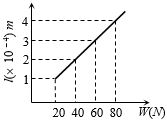
IIT 2003, Medium


Download our appand get started for free
Experience the future of education. Simply download our apps or reach out to us for more information. Let's shape the future of learning together!No signup needed.*
Similar Questions
- 1The ratio of radii of two wires of same material is $2: 1$. If these wires are stretched by equal force, the ratio of stresses produced in them is $.............$View Solution
- 2View SolutionIf the length of a wire is reduced to half, then it can hold the ......... load
- 3Two wires of equal lengths are made of the same material. Wire $A$ has a diameter that is twice as that of wire $B$. If identical weights are suspended from the ends of these wires, the increase in length isView Solution
- 4The area of cross-section of a wire of length $1.1$ metre is $1$ $mm^2$. It is loaded with $1 \,kg.$ If Young's modulus of copper is $1.1 \times {10^{11}}\,N/{m^2}$, then the increase in length will be ......... $mm$ (If $g = 10\,m/{s^2})$View Solution
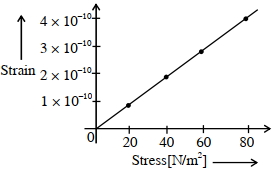
- 5The elastic behaviour of material for linear streass and linear strain, is shown in the figure. The energy density for a linear strain of $5 \times 10^{-4}$ is $\dots \; kJ / m ^{3}$. Assume that material is elastic upto the linear strain of $5 \times 10^{-4}$.View Solution
- 6View SolutionHooke's law is applicable for ....
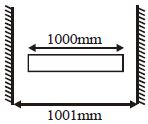
- 7$A$ rod of length $1000\, mm$ and coefficient of linear expansion $a = 10^{-4}$ per degree is placed symmetrically between fixed walls separated by $1001\, mm$. The Young’s modulus of the rod is $10^{11} N/m^2$. If the temperature is increased by $20^o C$, then the stress developed in the rod is ........... $MPa$View Solution
- 8An area of cross-section of rubber string is $2\,c{m^2}$. Its length is doubled when stretched with a linear force of $2 \times {10^5}$dynes. The Young's modulus of the rubber in $dyne/c{m^2}$ will beView Solution
- 9Given below are two statements: one is labelled as Assertion $A$ and the other is labelled as Reason $R$View Solution
Assertion $A$: Steel is used in the construction of buildings and bridges.
Reason $R:$ Steel is more elastic and its elastic limit is high.
In the light of above statements, choose the most appropriate answer from the options given below
- 10A pendulum consisting of a small sphere of mass $m$ suspended by an inextensible and massless string of length $l$ is made to swing in a vertical plane. If the breaking strength of the string is $2mg$ , then the maximum angular amplitude of the displacement from the vertical can be ....... $^o$View Solution