MCQ
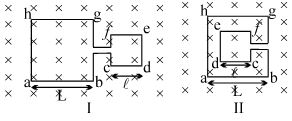
The adjoining figure shows two different arrangements in which two square wire frames are placed in a uniform constantly decreasing magnetic field $B.$ If $I_1$ and $I_2$ are the magnitudes of induced current in the cases $I$ and $II$, respectively, then
  • A
    $I_1 = I_2$
  • $I_1 > I_2$
  • C
    $I_1 < I_2$
  • D
    nothing can be said

Answer

Correct option: B.
$I_1 > I_2$
b

Need a full question paper?

Generate a complete, print-ready paper with questions like this in minutes — across 16+ boards, with answer keys.

Start Generating Free

Similar questions

A light ray is incident on the surface of a sphere of refractive index $n$ at an angle of incidence $\theta_0$. The ray partially refracts into the sphere with angle of refraction $\phi_0$ and then partly reflects from the back surface. The reflected ray then emerges out of the sphere after a partial refraction. The total angle of deviation of the emergent ray with respect to the incident ray is $\alpha$. Match the quantities mentioned in $List-I$ with their values in $List-II$ and choose the correct option.
$List-I$ $List-II$
($P$) If $n=2$ and $\alpha=180^{\circ}$, then all the possible values of $\theta_0$ will be ($1$) $30^{\circ}$ and $0^{\circ}$
($Q$) If $n=\sqrt{3}$ and $\alpha=180^{\circ}$, then all the possible values of $\theta_0$ will be ($2$) $60^{\circ}$ and $0^{\circ}$
($R$) If $n=\sqrt{3}$ and $\alpha=180^{\circ}$, then all the possible values of $\phi_0$ will be ($3$) $45^{\circ}$ and $0^{\circ}$
($S$) If $n=\sqrt{2}$ and $\theta_0=45^{\circ}$, then all the possible values of $\alpha$ will be ($4$) $150^{\circ}$
  ($5$) $0^{\circ}$
The value of a unit vector in the direction of vector $A = 5\hat i - 12\hat j,$ is
Proton $(P)$ and electron $(e)$ will have same deBroglie wavelength when the ratio of their momentum is (assume, $m _{ p }=1849\,m _{ e }$)
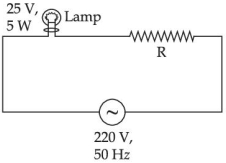
A $220 \; V , 50 \; Hz$ AC source is connected to a $25 \; V$, $5 \; W$ lamp and an additional resistance $R$ in series (as shown in figure) to run the lamp at its peak brightness, then the value of $R$ (in ohm) will be
An alternating voltage $v\left( t \right) = 220\,\sin \,100\pi l\,volt$ is applied to a purely resistive load of $50\,\Omega $ . The time taken for the current to rise from half of the peak value of the peak value is.....$ms$
Energy released in fusion of $1\, kg$ of deuterium nuclei
Two gases occupy two containers $A$ and $B$ the gas in $A$, of volume $0.10\,m ^3$, exerts a pressure of $1.40\,MPa$ and that in $B$ of volume $0.15 m ^3$ exerts a pressure $0.7\,MPa$. The two containers are united by a tube of negligible volume and the gases are allowed to intermingle. Then if the temperature remains constant, the final pressure in the container will be (in MPa)
A bar magnet has a magnetic moment equal to $5 \times {10^{ - 5}}\,weber \times m.$ It is suspended in a magnetic field which has a magnetic induction $(B) $ equal to $8\pi \times {10^{ - 4}}\,tesla.$ The magnet vibrates with a period of vibration equal to $15\, sec$. The moment of inertia of the magnet is
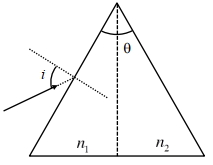
For a prism of prism angle $\theta=60^{\circ}$, the refractive indices of the left half and the right half are, respectively, $n_1$ and $n_2\left(n_2 \geq n_1\right)$ as shown in the figure. The angle of incidence $i$ is chosen such that the incident light rays will have minimum deviation if $n_1=n_2=n=1.5$. For the case of unequal refractive indices, $n_1=n$ and $n_2=n+\Delta n$ (where $\Delta n \ll n$ ), the angle of emergence $e=i+\Delta e$.

Which of the following statement($s$) is (are) correct?

$(A)$ The value of $\Delta e$ (in radians) is greater than that of $\Delta n$

$(B)$ $\Delta e$ is proportional to $\Delta n$

$(C)$ $\Delta e$ lies between 2.0 and 3.0 milliradians, if $\Delta n=2.8 \times 10^{-3}$

$(D)$ $\Delta e$ lies between 1.0 and 1.6 milliradians, if $\Delta n=2.8 \times 10^{-3}$
A hollow double concave lens is made of very thin transparent material. It can be filled with air or either of two liquids $L_1$ and $L_2$ having refractive indices $n_1$ and $n_2$ respectively ($n_2>n_1>1$). The lens will diverge a parallel beam of light if it is filled with