MCQ
The adsorption of hydrogen by platinum black is called:
- AHydrogenation
- BReduction
- ✓Occlusion
- DHydration
Generate a complete, print-ready paper with questions like this in minutes — across 16+ boards, with answer keys.
gly $=$ glycinato; bpy $=2,2$ '-bipyridine
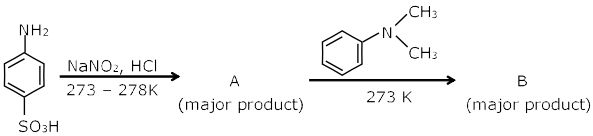
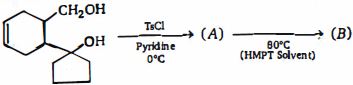
Given that $\left.\frac{2.303 \mathrm{RT}}{\mathrm{F}}=0.059 \mathrm{V} \text { at } \mathrm{T}=298 \mathrm{K}\right]$
(image) $\xrightarrow{{B{r_3} + C{H_3} - COOH}}A\xrightarrow{{Alc.KOH}}B$ (Product with six membered ring) $\xrightarrow[{(2)\,{H_2}O}]{{(1)\,C{H_3} - MgBr}}C\xrightarrow{{{H^ \oplus } + \Delta }}D\xrightarrow{{HBr(1\,mole)}}E$
$(i)\,\,$on doubling the initial concentration of $A$ only, the rate of reaction is also doubled and
$(ii)$ on doubling the initial concentration of both $A$ and $B,$ there is a change by a factor of $8$ in the rate of the reaction.
The rate of this reaction is given by