MCQ
The alcohol which does not give a stable compound on dehydration is
  • A
    Ethyl alcohol
  • Methyl alcohol
  • C
    $n-$propyl alcohol
  • D
    $n-$butyl alcohol

Answer

Correct option: B.
Methyl alcohol
b
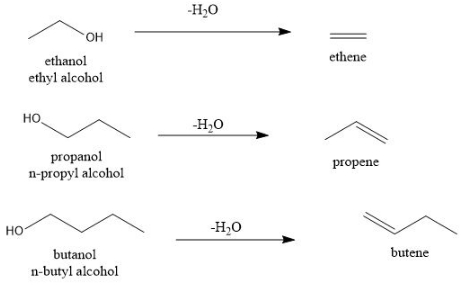
Alcohols undergo dehydration (removal of water) to form an alkene.

To form alkene, we need at least two carbon atoms. But, methanol $\left( CH _3 OH \right)$ has only one carbon atom. So, it does not give a stable compound on dehydration.
Need a full question paper?

Generate a complete, print-ready paper with questions like this in minutes — across 16+ boards, with answer keys.
Start Generating Free

Similar questions

Which one of the following statements is wrong
Select the salt whose aqueous solution is not green
At $527\,^{\circ} C$ temperature the activation energy is $54.7 \,KJ / mole$ The value of Arrhenius factor is $4 \times 10^{10} .$ The rate constant will be
Which of the following statement is correct
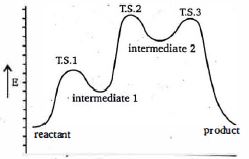
Transition state $2$ is structurally most likely as
When a certain amount of solid $A$ is dissolved in $100\,g$ of water at $25^{\circ}\,C$ to make a dilute solution, the vapour pressure of the solution is reduced to one-half of that of pure water. The vapour pressure of pure water is $23.76\,mm\,Hg$. The number of moles of solute $A$ added is $...........$ (Nearest Integer)
The equivalent conductance of benzoic acid is $12.8\, ohm^{-1}\,cm^2\,eq^{-1}$. If conductance of benzoate ion and $H^+$ ion at infinite dilution is $42$ and $288.42\, ohm^{-1}\, cm^2$ respectively. Its degree of dissociation is ............. $\%$
$\begin{matrix}
   O\,\,\,\,\,\,\,\,\,\,\,\,\,\,\,\,\,\,\,\,\,\,  \\
   ||\,\,\,\,\,\,\,\,\,\,\,\,\,\,\,\,\,\,\,\,\,\,  \\
   R-C-R\underset{(catalyst)}{\overset{HCN}{\longleftrightarrow}}  \\
\end{matrix}\begin{matrix}
   \,\,\,\,\,OH  \\
   |  \\
   R-C-R  \\
   |  \\
   \,\,\,\,CN  \\
\end{matrix}$

Which of following can be used as a catalyst in the above reaction?

benzene $+ HN{O_{3\left( {conc.} \right)}}\xrightarrow{{{H_2}S{O_4}}}A\xrightarrow[{\left( {ii} \right)\,O{H^ - }}]{{\left( i \right)\,Sn/HCl}}B\xrightarrow[{0 - 5{\,^o}C}]{{NaN{O_2} + HCl}}C\xrightarrow{{{H_2}O/{H^ + }}}D$ What is $D$
Which statement is not correct about alcohol