MCQ
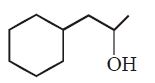
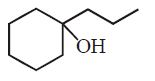
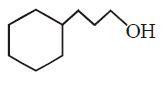
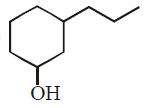
The alcohol which show turbidity immediate when reacted with $(HCl + ZnCl_2)$
  • A


  • C

  • D

Answer

Correct option: B.

b
$3^o$-alcohol give terbidity immediate.

Need a full question paper?

Generate a complete, print-ready paper with questions like this in minutes — across 16+ boards, with answer keys.
Start Generating Free

Similar questions

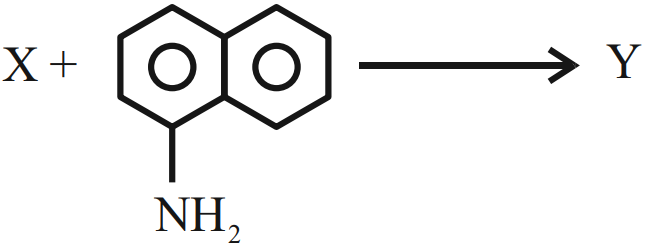
The azo-dye $( Y )$ formed in the following reactions is Sulphanilic acid $+ NaNO _2+ CH _3 COOH \rightarrow X$

Image
$5.1\, g\, NH_4SH$ is introduced in $3.0\, L$ evacuated flask at $327\,^oC$. $30\%$ of the solid $NH_4SH$ decomposed to $NH_3$ and $H_2S$ as gases. The $K_p$ of the reaction at $327\,^oC$ is

($R = 0.082\, L\, atm\, mol^{-1}\, K^{-1}$, Molar mass of $S = 32\, g\, mol^{-1}$, molar mass of $N = 14\, g\, mol^{-1}$)

The uncertainties in the velocities of two particles, $A$ and $B$ are $0.05$ and $0.02\, ms^{-1}$ respectively. The mass of $B$ is five times to that of the mass of $A$. What is the ratio of uncertainties $\frac{{\Delta {x_A}}}{{\Delta {x_B}}}$ in their positions ?
Determine enthalpy of formation for $H_2O_2(\ell ),$  using listed enthalpies of reaction

${N_2}{H_4}(l)\,+\,2{H_2}{O_2}(l)\,\, \to \,{N_2}(g)\,\, + \,4{H_2}O(l);\,\,{\Delta _r}H_1^o\, = \, - 818\,\,kJ/mol$

${N_2}{H_4}(l)\,\, + {O_2}(g)\,\, \to \,{N_2}(g)\,\, + \,2{H_2}O(l);\,\,{\Delta _r}H_2^o\, = \, - 622\,\,kJ/mol$

${H_2}(g)\,\, + 1/2{O_2}(g)\,\, \to \,{H_2}O(l);\,\,{\Delta _r}H_3^o\, = \, - 285\,\,kJ/mol$

......$kJ/mol$

Benzene undergoes substitution reaction more easily than addition because:
Which of the following option is incorrect
Some pairs of ions are given below. In which pair, first ion is more stable than second?
$C{H_3} - C{H_2} - C{H_2} - C \equiv CH\xrightarrow[{Excess}]{{HCl}}$ ?
If the solubility product ${K_{sp}}$ of a sparingly soluble salt $M{X_2}$ at $25\,^oC$ is $1.0 \times {10^{ - 11}}$, the solubility of the salt in mole litre$^{-1}$ at this temperature will be
The plot of osmotic pressure (П) vs concentration $\left(\mathrm{mol} \mathrm{L}^{-1}\right)$ for a solution gives a straight line with slope $25.73 \mathrm{~L} \mathrm{bar} \mathrm{mol}^{-1}$. The temperature at which the osmotic pressure measurement is done is

(Use $\mathrm{R}=0.083 \mathrm{~L}$ bar mol $\mathrm{m}^{-1} \mathrm{~K}^{-1}$ )