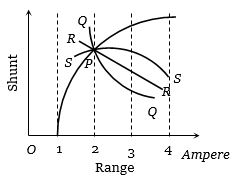
The ammeter has range $1\, ampere$ without shunt. the range can be varied by using different shunt resistances. The graph between shunt resistance and range will have the nature
Medium
Download our app for free and get started
(b) To make range $n$ times, the galvanometer resistance should be $G /n$, where $G$ is initial resistance.
Download our app
and get started for free
Experience the future of education. Simply download our apps or reach out to us for more information. Let's shape the future of learning together!No signup needed.*
A wire carrying a current $I$ is placed inside a uniform magnetic field $\vec B=-B_0\hat k$. The shape of the wire is parabolic and has equation $Y = 2x -x^2.$ The force on the wire will be :
A long solenoid is formed by winding $20$ $turns/cm$. The current necessary to produce a magnetic field of $20$ $milli\,tesla$ inside the solenoid will be approximately .....$A$ $(\frac{{{\mu _0}}}{{4\pi }} = {10^{ - 7}}\,tesla - metre/ampere)$
A magnet of magnetic moment $ 20 $ $C.G.S.$ units is freely suspended in a uniform magnetic field of intensity $0.3 $ $ C.G.S.$ units. The amount of work done in deflecting it by an angle of $30°$ in $ C.G.S.$ units is
Circular loop of a wire and a long straight wire carry currents $I_c$ and $I_e$, respectively as shown in figure. Assuming that these are placed in the same plane, the magnetic fields will be zero at the centre of the loop when the separation $H$ is
An infinitely long hollow conducting cylinder with inner radius $R / 2$ and outer radius $R$ carries a uniform current density along is length. The magnitude of the magnetic field, $|\vec{B}|$ as a function of the radial distance $r$ from the axis is best represented by:
A circular coil ‘$A$’ has a radius $R$ and the current flowing through it is $I$. Another circular coil ‘$B$’ has a radius $2R$ and if $2I$ is the current flowing through it, then the magnetic fields at the centre of the circular coil are in the ratio of (i.e.${B_A}$ to ${B_B}$)
A deuteron and an alpha particle having equal kinetic energy enter perpendicular into a magnetic field. Let $r_{d}$ and $r_{\alpha}$ be their respective radii of circular path. The value of $\frac{r_{d}}{r_{\alpha}}$ is equal to
Two infinitely long wires each carrying current $I$ along the same direction are made into the geometry as shown in the figure below. The magnetic field at the point $P$ is