MCQ
The angle between the two vectors $\vec A = 3\hat i + 4\hat j + 5\hat k$ and $\vec B = 3\hat i + 4\hat j - 5\hat k$ will be....... $^o$
  • $90$
  • B
    $0$
  • C
    $60$
  • D
    $45$

Answer

Correct option: A.
$90$
a
(a) $\cos \theta = \frac{{\overrightarrow A .\overrightarrow B }}{{|A||B|}} = \frac{{(3\hat i + 4\hat j + 5\hat k)\,(3\hat i + 4\hat j - 5\hat k)}}{{\sqrt {9 + 16 + 25} \sqrt {9 + 16 + 25} }}$

$ = \frac{{9 + 16 - 25}}{{50}} = 0$

$⇒$ $\cos \theta = 0$,

$\therefore $ $\theta = 90^\circ $
 

Need a full question paper?

Generate a complete, print-ready paper with questions like this in minutes — across 16+ boards, with answer keys.
Start Generating Free

Similar questions

A wire of density $9 \times 10^3 kg /m^3$ is stretched between two clamps $1 m$ apart and is subjected to an extension of $4.9 \times 10^{-4} m$. The lowest frequency of transverse vibration in the wire is ..... $Hz$ ($Y = 9 \times 10^{10} N / m^2$)
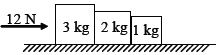
Three blocks of masses $3\, kg, 2\, kg$ and $1\, kg$ are placed side by side on a smooth  surface as shown in figure. A horizontal force of $12\,N$ is applied to $3\, kg$ block. The  net force on $2\, kg$ block is ............ $N$
If a ball is thrown at a velocity of $45 \,m / s$ in vertical upward direction, then what would be the velocity profile as function of height? (Assume, $g=10 \,m / s ^2$ )
When heat in given to a gas in an isobaric process, then
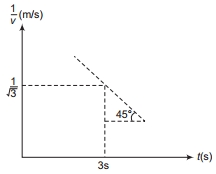
The diagram shows the variation of $1 / v$ (where, $v$ is velocity of the particle) with respect to time. At time $t=3\,s$ using the details given in the graph, the instantaneous acceleration will be equal to $...........m/s^{2}$
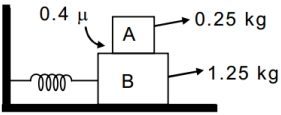
Maximum amplitude(in $cm$) of $SHM$ so block A will not slip on block $B , K =100 N / m$
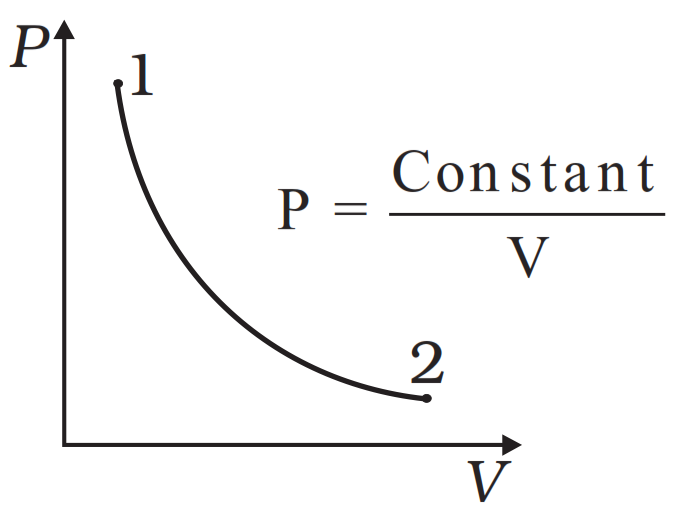
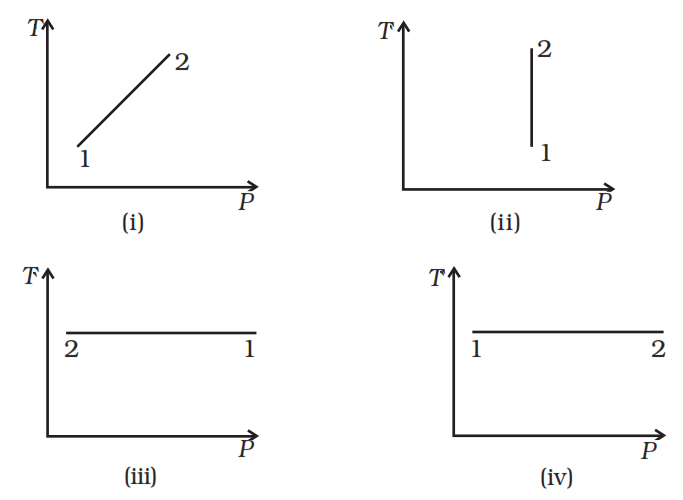
Consider P-V diagram for an ideal gas shown in:

Out of the following diagrams which represents the T-P diagram?
An air column in a pipe, which is closed at one end, will be in resonance with a vibrating body of frequency $166 \,Hz$, if the length of the air column is .... $m$
A rope of mass $5 \,kg$ is moving vertically in vertical position with an upwards force of $100 N$ acting at the upper end and a downwards force of $70 N$ acting at the lower end. The tension at midpoint of the rope is ......... $N$
A solid sphere, of radius $R$ acquires a terminal velocity $\nu_1 $ when falling (due to gravity) through a viscous fluid having a coefficient of viscosity $\eta $. The sphere is broken into $27$ identical solid spheres. If each of these spheres acquires a terminal velocity, $\nu_2$, when falling through the same fluid, the ratio $(\nu_1/\nu_2)$ equals