MCQ
The angle between the vectors $i - j + k$ and $i + 2j + k$ is
  • A
    ${\cos ^{ - 1}}\left( {\frac{1}{{\sqrt {15} }}} \right)$
  • B
    ${\cos ^{ - 1}}\left( {\frac{4}{{\sqrt {15} }}} \right)$
  • C
    ${\cos ^{ - 1}}\left( {\frac{4}{{15}}} \right)$
  • $\frac{\pi }{2}$

Answer

Correct option: D.
$\frac{\pi }{2}$
d
(d) $(i - j + k)\,.\,(i + 2j + k) = \sqrt 3 \sqrt 6 \cos \theta $

$ \Rightarrow \cos \theta = \frac{0}{{\sqrt 3 \sqrt 6 }} \Rightarrow \theta = \frac{\pi }{2}.$

Need a full question paper?

Generate a complete, print-ready paper with questions like this in minutes — across 16+ boards, with answer keys.

Start Generating Free

Similar questions

The value of $\hat{i} \cdot(\hat{j} \times \hat{k})+\hat{j} \cdot(\hat{i} \times \hat{k})+\hat{k}(\hat{i} \times \hat{j})$ is
If $(\text{a}+\text{b}-\text{x})=\text{f}(\text{x}),$ then $\int\limits^\text{b}_\text{a}\text{x f}(\text{x})\text{dx}$ is equal to:
Let $A = \{2, 3, 4, 5, ..., 17, 18\}.$ Let $'\simeq\ '$ be the equivalence relation on $A \times A,$ cartesian product of $A$ with itself, defined by $(\text{a, b})\simeq(\text{c, d)}$ if $ad = bc.$ Then, the number of ordered pairs of the equivalence class of $(3, 2)$ is:
The value of $\cos^{-1}\Big(\cos\frac{5\pi}{3}\Big)+\sin^{-1}\Big(\sin\frac{5\pi}{3}\Big)$ is:
If $2tan^{-1}(cosx) = tan^{-1}(cosec^2x)$ then $x =$
Let the area of the region $\{(x, y): x-2 y+4 \geq 0$, $\left.x+2 y^2 \geq 0, x+4 y^2 \leq 8, y \geq 0\right\}$ be $\frac{m}{n}$, where $m$ and $\mathrm{n}$ are coprime numbers. Then $\mathrm{m}+\mathrm{n}$ is equal to
Let $r$ be a relation from $R$ (set of real numbers) to $R$ defined by $r = \{(a,b) \, | a,b \in R$  and  $a - b + \sqrt 3$ is an irrational number$\}$ The relation $r$ is
A bag contains $5$ red and $3$ blue balls. If $3$ balls are drawn at random without replacement, then the probability that exactly two of the three balls were red, the first ball being red, is
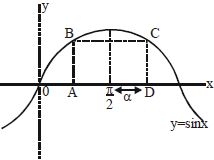
A rectangle $ABCD$ is inscribed in the region bounded by $y = \sin x, \, x-$ axis where $x \in [0,\pi ]$ (as shown in figure), then area of rectangle is maximum when $'\alpha '$ satisfies
The function $f: R \rightarrow R$ defined by $f(x)=4+3 \cos x$ is