MCQ
The angle between two diagonals of a cube will be
  • A
    ${\sin ^{ - 1}}1/3$
  • ${\cos ^{ - 1}}1/3$
  • C
    Variable
  • D
    None of these

Answer

Correct option: B.
${\cos ^{ - 1}}1/3$
b
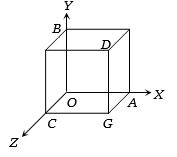
(b) Let the cube be of side $'a'$

$O\,(0,\,\,0,\,\,0),\,\,D\,(a,\,\,a,\,\,a),\,\,B\,(0,\,\,a,\,\,0),\,\,G\,(a,\,\,0,\,\,a)$

Then equation of $OD$ and $BG$ are $\frac{x}{a} = \frac{y}{a} = \frac{z}{a}$ and

$\frac{x}{a} = \frac{{y - a}}{{ - a}} = \frac{z}{a}$ respectively.

Hence, angle between $OD$ and $BG$ is

${\cos ^{ - 1}}\left( {\frac{{{a^2} - {a^2} + {a^2}}}{{\sqrt {3{a^2}} .\,\sqrt {3{a^2}} }}} \right) = {\cos ^{ - 1}}\,\left( {\frac{1}{3}} \right)$.
Need a full question paper?

Generate a complete, print-ready paper with questions like this in minutes — across 16+ boards, with answer keys.

Start Generating Free

Similar questions

The greater of $\int_0^{\pi /2} {\frac{{\sin x}}{x}\,dx} $ and $\frac{\pi }{2},$ is
The points of intersection of
${F_1}(x) = \int_2^x {(2t - 5)\,dt} $ and ${F_2}(x) = \int_0^x {2t\,dt,} $ are
What is the order of the product- $\begin{bmatrix}\text{x}&\text{amp;}\text{ y}&\text{amp;}\text{ z}\end{bmatrix}\begin{bmatrix}\text{a} &\text{amp;}\text{ h}&\text{amp;}\text{ g} \\\text{h} &\text{amp;}\text{ b}&\text{amp; }\text{f}\\\text{g} &\text{amp;}\text{ f}&\text{amp; }\text{c} \end{bmatrix}\begin{bmatrix}\text{x}\\\text{y}\\\text{z}\end{bmatrix}$ is:
  1. $3\times1$
  2. $1\times1$
  3. $1\times3$
  4. $3\times3$
Let $[x]$ denotes the greatest integer less than or equal to $x$. If $f(x) = [x\sin \pi x]$, then $f(x)$ is
What will be the value of $k$ for which $f(x)=$
$\left\{\begin{array}{c}\frac{\sin 3 x}{x}, x \neq 0 \\ k \quad, x=0\end{array}\right.$ is continuous at $x=0$.
The solution of the differential equation $\frac{dy}{dx}= \frac{y}{(y^2-x)}$ is
The area of the region between the curves $y=\sqrt{\frac{1+\sin x}{\cos x}}$ and $y=\sqrt{\frac{1-\sin x}{\cos x}}$ bounded by the lines $x=0$ and $x=\frac{\pi}{4}$ is
Let $A$ denote the area bounded by the curve $y=\frac{1}{x}$ and the lines $y=0, x=1, x=10$, let $B=1+\frac{1}{2}+\ldots+\frac{1}{9}$, and let $C=\frac{1}{2}+\frac{1}{3}+\ldots+\frac{1}{10}$. Then,
If $f(x)=\int_0^x e^{t^2}(t-2)(t-3) d t$ for all $x \in(0, \infty)$, then

$(A)$ $f$ has a local maximum at $x=2$

$(B)$ $f$ is decreasing on $(2,3)$

$(C)$ there exists some $c \in(0, \infty)$ such that $f ^{\prime \prime}( c )=0$

$(D)$ $f$ has a local minimum at $x=3$

The differention equation $\frac{\text{dy}}{\text{dx}}+\text{P}\text{y}=\text{Qy}^{\text{n}},\text{n}>2$ can be reduced to linear from by substituting:  
  1. $\text{z}=\text{y}^{\text{n}-1}$ 
  2. $\text{z}=\text{y}^{\text{n}}$
  3. $\text{z}=\text{y}^{\text{n}+1}$
  4. $\text{z}=\text{y}^{1-\text{n}}$