MCQ
The angle between two vectors $4\hat i + 3\hat j + \hat k$ and $-3\hat i + 2\hat j + 6\hat k$ is ....... $^o$
  • A
    $0$
  • B
    $45$
  • C
    $60$
  • $90$

Answer

Correct option: D.
$90$
d
$\cos \theta=\frac{\overrightarrow{\mathrm{A}} \overrightarrow{\mathrm{B}}}{\mathrm{AB}}=\frac{(4 \hat{\mathrm{i}}+3 \hat{\mathrm{j}}+\hat{\mathrm{k}}) \cdot(-3 \hat{\mathrm{i}}+2 \hat{\mathrm{j}}+6 \hat{\mathrm{k}})}{\sqrt{26} \sqrt{49}}=0$

$\therefore \theta=90^{\circ}$

Need a full question paper?

Generate a complete, print-ready paper with questions like this in minutes — across 16+ boards, with answer keys.
Start Generating Free

Similar questions

Hanging in a spring m the period of oscillation of the mass is T. Oscillations are made by cutting the spring in half and hanging double the mass on it. Now the period of oscillation will be :
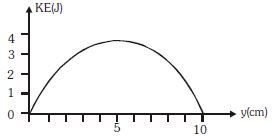
A mass on a vertical spring begins its motion at rest at $y = 0\  cm$. It reaches a maximum height of $y = 10\  cm$. The two forces acting on the mass are gravity and the spring force. The graph of its kinetic energy ($KE$) versus position is given below. Net force on the mass varies with $y$ as
The linear momentum $p$ of a body of mass $5 \,kg$ varies with time $t$ as, $p = 5t^2 + t + 5$ It follows that the body is moving with
On celcius scale the temperature of body increases by $40^{\circ} \mathrm{C}$. The increase in temperature on Fahrenheit scale is:
A quantity of heat required to change the unit mass of a solid substance, from solid state to liquid state, while the temperature remains constant, is known as
The trajectory of projectile, projected from the ground is given by $y=x-\frac{x^2}{20}$. Where $x$ and $y$ are measured in meter. The maximum height attained by the projectile will be $...........\,m$
A liquid boils when its vapour pressure equals
The Young's modulus of a rubber string $8\, cm$ long and density $1.5\,kg/{m^3}$ is $5 \times {10^8}\,N/{m^2}$, is suspended on the ceiling in a room. The increase in length due to its own weight will be
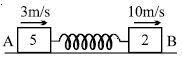
Two blocks $A(5kg)$ and  $B(2kg)$ attached to the ends of a spring constant $1120N/m$ are placed on a smooth horizontal plane with the spring undeformed. Simultaneously velocities of $3m/s$ and $10m/s$ along the line of the spring in the same direction are imparted to $A$ and $B$ then
A force $F = (5\hat i + 3\hat j)$ newton is applied over a particle which displaces it from its origin to the point $r = (2\hat i - 1\hat j)$ metres. The work done on the particle is....$joules$