Question
The angle of dip is the angle

Answer

(c) The angle of dip is the angle between the direction of the earth's magnetic field and the plane of the horizon

Horizontal component of earth's magnetic field $=B_{H}=B \cos \theta$

Vertical component of earth's magnetic field $=B_{V}=B \sin \theta$

Now, $B \cos \theta=B \sin \theta$

$\Longrightarrow \theta=45^{\circ}$

Need a full question paper?

Generate a complete, print-ready paper with questions like this in minutes — across 16+ boards, with answer keys.
Start Generating Free

Similar questions

The variation of electrostatic potential with radial distance $r$ from the centre of a positively charged metallic thin shell of radius $R$ is given by the graph
Four wires of identical length, diameters and of the same material are stretched on a sonometre wire. If the ratio of their tensions is $1 : 4 : 9 : 16$ then the ratio of their fundamental frequencies are
A particle moves in a horizontal circle on the smooth inner surface of a hemispherical bowl of radius $R$. The plane of motion is at a depth $d$ below the centre of the hemisphere. The speed of the particle is :-
A hot and a cold body are kept in vacuum separated from each other. Which of the following cause decrease in temperature of the hot body
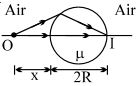
The figure, shows a transparent sphere of radius $R$ and refractive index $\mu$ . An object $O$ is placed at a distance $x$ from the pole of the first surface so that a real image is formed at the pole of the exactly opposite surface. If $x = 2R$, then the value of $\mu$ is
For a transistor the parameter $\beta = 99$. The value of the parameter $\alpha$ is
A body starts from rest with uniform acceleration $a,$  its velocity after $n\,seconds$ is $v$. The displacement of the body in last $3\,s$ is : (assume total time of journey from $0$ to $n\,seconds$ )
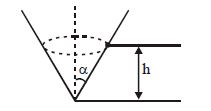
A particle is describing circular motion in a horizontal plane in contact with the smooth inside surface of a fixed right circular cone with its axis vertical and vertex down. The height of the plane of motion above the vertex is $h$ and the semivertical angle of the cone is $\alpha $ . The period of revolution of the particle
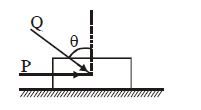
A block of mass $m$ lying on a rough horizontal plane is acted upon by a horizontal force $P$ and another force $Q$ inclined an at an angle $\theta $ to the vertical. The minimum value of coefficient of friction between the block and the surface for which the block will remain in equilibrium is
The magnetic moment of a current $(i)$ carrying circular coil of radius $(r)$ and number of turns $(n)$ varies as